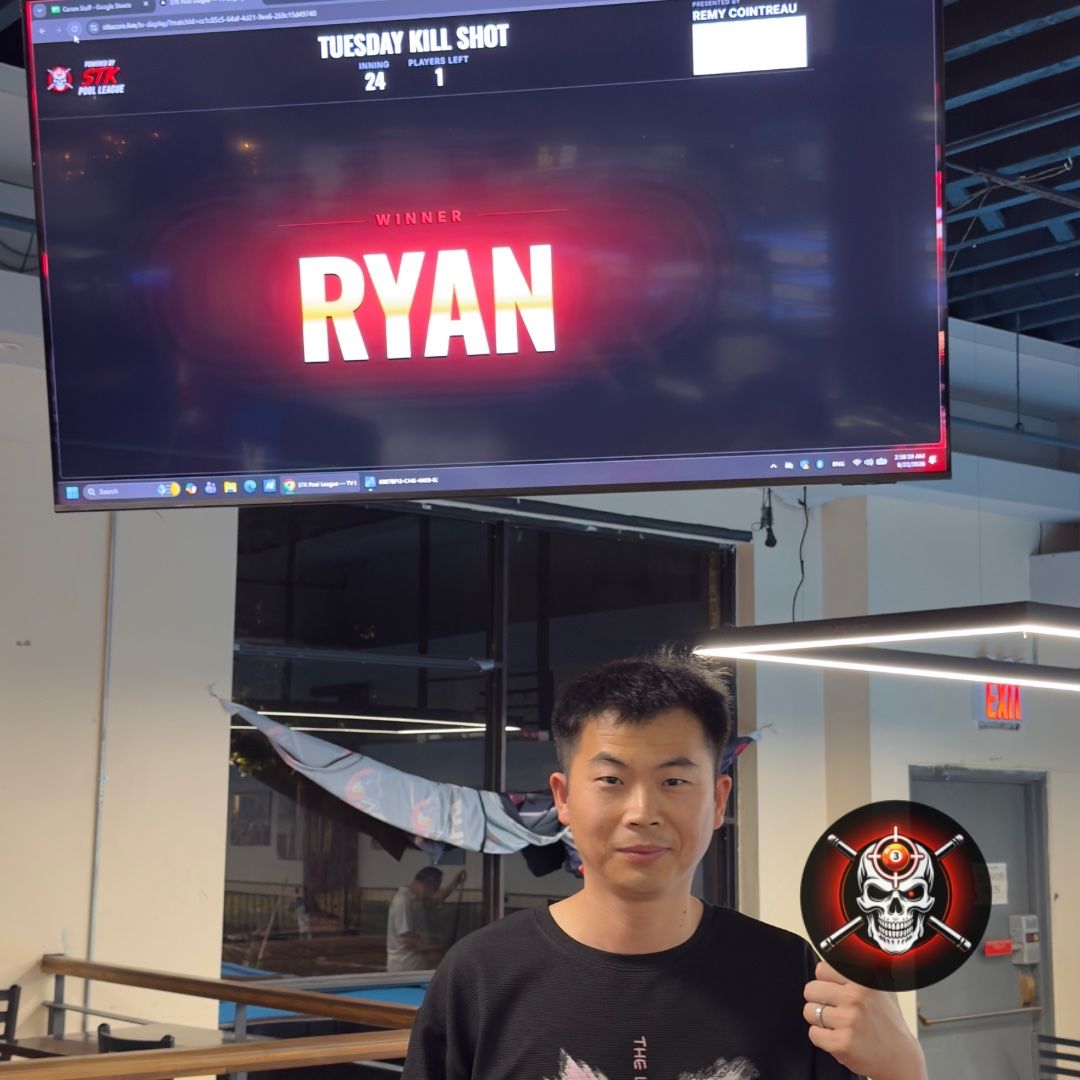
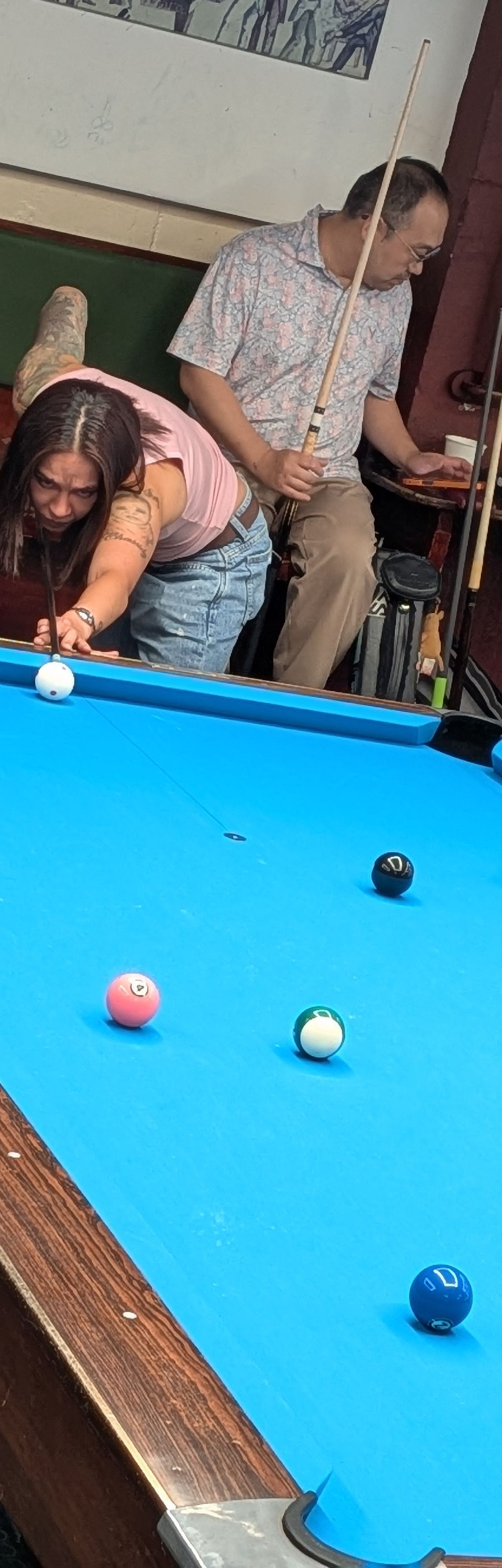
He won on his first try! Congrats on qualifying for the championship, Ryan!
STK
STK
Sep 21
STK Carom Cafe & Billiards Monday Recap
Match complete / Winners circle
ROOM CONQUERED. TICKET PUNCHED.
RYAN
Bounty
Carom Cafe & Billiards
Championship qualifier
W
Bounty bonus
NEIL TOOK OUT DARWIN.
+1 LIFE
Previous winner bounty · +1 regular-match credit
Bounty bonus
RYAN TOOK OUT NEILLE.
+1 LIFE
Host bounty · +1 regular-match credit
Bounty bonus
RYAN TOOK OUT NEIL.
+1 LIFE
Previous winner bounty · +1 regular-match credit
Bounty bonus
RYAN TOOK OUT DUC L.
+1 LIFE
Previous winner bounty · +1 regular-match credit
1 / 5
STK
STK
Sep 20
STK Globe Tavern Sunday Recap
Match complete / Winners circle
ROOM CONQUERED. TICKET PUNCHED.
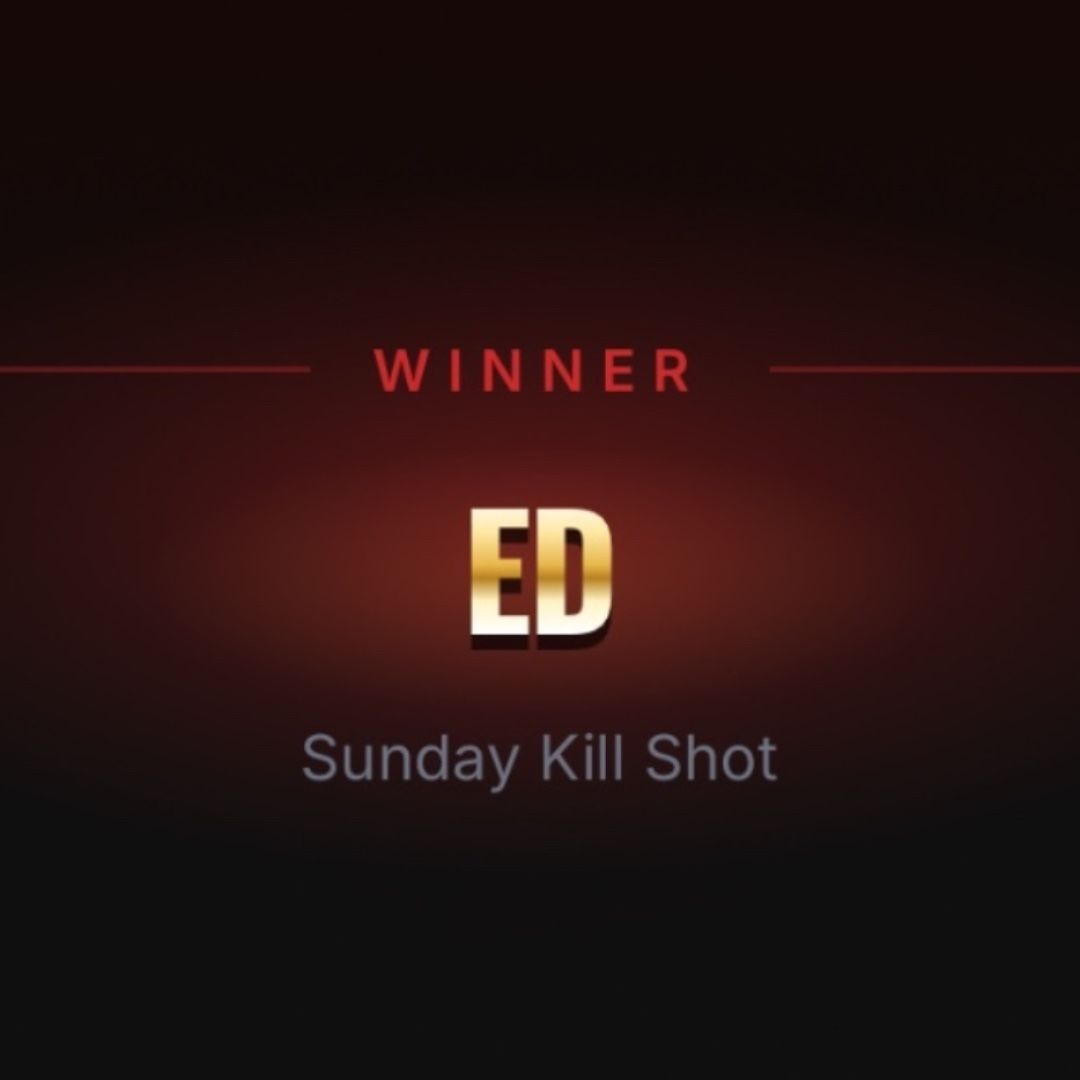
ED S.
Bounty
The Globe Tavern
Championship qualifier
W
Match complete / Winners circle
ROOM CONQUERED. TICKET PUNCHED.
NEILLE
Bounty
The Globe Tavern
Championship qualifier · +1 Championship life
W
Bounty bonus
ED S. TOOK OUT MILLIE P.
+1 LIFE
Previous winner bounty · +1 regular-match credit
Bounty bonus
ED S. TOOK OUT NEILLE.
+1 LIFE
Host bounty · +1 regular-match credit
Bounty bonus
ED S. TOOK OUT DILLY.
+1 LIFE
Previous winner bounty · +1 regular-match credit
Bounty bonus
NEILLE TOOK OUT ED S.
+1 LIFE
Previous winner bounty · +1 regular-match credit
Bounty bonus
NEILLE TOOK OUT MILLIE P.
+1 LIFE
Previous winner bounty · +1 regular-match credit
Bounty bonus
DEBORAH B. TOOK OUT DILLY.
+1 LIFE
Previous winner bounty · +1 regular-match credit
1 / 10
STK
STK
Sep 17
STK Carom Cafe & Billiards Thursday Recap
Match complete / Winners circle
ROOM CONQUERED. TICKET PUNCHED.
NEIL
Bounty
Carom Cafe & Billiards
Championship qualifier
W
Bounty bonus
NEILLE TOOK OUT DARWIN.
+1 LIFE
Previous winner bounty · +1 regular-match credit
Bounty bonus
DUC L. TOOK OUT MHET V.
+1 LIFE
Previous winner bounty · +1 regular-match credit
Bounty bonus
DUC L. TOOK OUT NEILLE.
+1 LIFE
Host bounty · +1 regular-match credit
Bounty bonus
NEIL TOOK OUT DUC L.
+1 LIFE
Previous winner bounty · +1 regular-match credit
1 / 5
NC
Neille C.
Sep 16, 9:54 AM
Who's coming to play STK at Carom on Thursday?
STK
STK
Sep 14
STK Carom Cafe & Billiards Monday Recap
Winners circle
DUC IS MAXED OUT.
+1 LIFE
Championship: 3 base + 2 bonus = 5 lives · Cap reached
STK
STK
League recap · Win 2
Uh-oh! Duc has an extra life in the championship! Two wins, a couple of matches apart.
Winners circle
UH-OH! DUC DID IT AGAIN.
+1 LIFE
Championship: 3 base + 1 bonus = 4 lives
STK
STK
League recap · Bounty claimed
Neille eliminated Duc between his two wins and earned a bounty bonus.
Bounty bonus
NEILLE TOOK OUT DUC.
+1 LIFE
+1 regular-match credit
M
Michelle
Sep 10, 4:00 AM
Who’s coming to the Globe Tavern on Sunday?
STK
STK
League recap · Win 1
Duc takes his first win and qualifies for the championship.
Winners circle
ROOM CONQUERED. TICKET PUNCHED.
Championship qualified · 3 base lives
STK
STK
Sep 7
STK Monday Recap
Match complete / Winners circle
ROOM CONQUERED. TICKET PUNCHED.
MIKE D.
Bounty
Championship qualifier
W
1 / 5
STK
STK
Sep 6
STK Globe Tavern Sunday Recap
Match complete / Winners circle
ROOM CONQUERED. TICKET PUNCHED.
SUZZIE
Bounty
Championship qualifier
W
Match complete / Winners circle
ROOM CONQUERED. TICKET PUNCHED.
CLAUDIO
Bounty
Championship qualifier
W
1 / 2
STK
STK
Sep 3
STK Carom Cafe & Billiards Thursday Recap
Match complete / Winners circle
ROOM CONQUERED. TICKET PUNCHED.
CARMINE
Bounty
Championship qualifier
W
STK
STK
Aug 30
STK Globe Tavern Sunday Recap
Match complete / Winners circle
ROOM CONQUERED. TICKET PUNCHED.
MILLIE
Bounty
Championship qualifier
W
Match complete / Winners circle
ROOM CONQUERED. TICKET PUNCHED.
MICHELLE
Bounty
Championship qualifier
W
Match complete / Winners circle
ROOM CONQUERED. TICKET PUNCHED.
DILLY
Bounty
Championship qualifier
W
1 / 7
Show up. Shoot your shot.
Find your room
All times New York
Show up. Shoot your shot.
Venues
STK venues
Rooms running STK now.
Pending activation
Hit 15 votes. Getting set up.
Nominated
Sorted by votes, highest first.
Special nights
Events
Add event
The last ones standing
Winners circle
Season prize pool
of the season goal
0%20%40%60%80%100%
Road to the championship
ONE WIN. YOU’RE IN.
Win a match and advance to the championship.
Bounty Eliminate a previous winner to earn an extra life while you’re still active.
D
Duc
Bounty
Thursday Night Kill Shot · Sep 11
10 points
2 wins · 4 championship lives
MD
Mike D.
Bounty
Monday Night Kill Shot · Sep 8
14 points
C
Claudio
Bounty
Sunday Night Kill Shot · Sep 7
20 points
S
Suzzie
Bounty
Sunday Night Kill Shot · Sep 6
19 points
C
Carmine
Bounty
Thursday Night Kill Shot · Sep 4
15 points
D
Duke
Bounty
Friday Night Killer · Sep 1
12 points
D
Dilly
Bounty
Friday Night Killer · Aug 30
9 points
M
Michelle
Bounty
Friday Night Killer · Aug 30
11 points
M
Millie
Bounty
Friday Night Killer · Aug 30
14 points
M
Mhet
Bounty
Friday Night Killer · Aug 28
14 points
N
Neille
Bounty
Friday Night Killer · Aug 24
20 points
D
Dominic
Bounty
Friday Night Killer · Aug 24
16 points
K
Kool-Aid
Bounty
Friday Night Kill Shot · Aug 22
14 points
L
Leon
Bounty
Friday Night Kill Shot · Aug 21
10 points
D
Darwin
Bounty
Thursday Kill Shot · Aug 21
15 points
J
Jesus
Bounty
Friday Night Kill Shot · Aug 20
6 points
Know the game
Rules of the room
Watch: How to get on the STK Roster
STK Kill Shot Rules
Everyone plays at once. Players shoot in order. Player order is shuffled before the match starts. You get one shot per turn. All you have to do is make a ball - slop counts. If you miss, scratch, or foul, you get a strike. Reach your strike limit and you're eliminated.
Everyone starts the game with a 3-strike limit. In this series, you can purchase up to 2 more strikes for $5 each.
Pot a ball — no strike, next player shoots
Miss, scratch, or foul — you take a strike
Once you hit your strike limit, you're eliminated.
Breaks
If you break dry, you may shoot again. If you pot at least one ball on the break, the next player shoots. Any 4 balls must make contact with a rail for the break to be legal.
Shot clock
There is a 60-second shot clock if you need coaching on a shot.
Additional shot clocks for players who repeatedly slow down play: 30 seconds to approach the table, 60 seconds to shoot.
Fouls
Only cue ball fouls are counted as strikes.
An object ball that comes off the table also results in a strike and remains off the table.
Conduct
Banter is welcomed. Rudeness is never tolerated.
Earn Extra Lives
Refer a new player who registers, make two food or beverage orders during a match, or eliminate Neille or any previous Kill Shot winner to earn an extra life. But if you are eliminated before one of the players with a bounty is eliminated, you do not receive an extra life. You must still be active on the scoreboard to receive the extra life bounty.
These lives are added to your player account and may be saved or used during any regular Kill Shot Series match.
Extra lives earned through referrals, purchases, or bounties cannot be used at the Championship. Championship extra lives can only be earned by winning qualifying matches.
Entry Fee
$25 entry fee per match
Player Incentives
Refer new players: earn extra lives to use in any regular series match of your choosing.
Eliminate Neille: earn a bounty extra life.
Eliminate a previous match winner: earn a bounty extra life.
Earn a bonus life for placing two food or beverage orders per match in one night. If there are multiple matches, there are multiple opportunities to earn lives.
Win a regular match: qualify for the $5000 Championship. Win multiple matches, earn Championship lives (max 2 bonus, 5 lives total).
Championship lives can only be earned by winning matches. Referral, purchase, bounty rewards cannot create Championship lives.
Last player standing wins.
Your place in the league
Player profile
Grow the league
Invite friends
Send a private link. Invite friends to THE pool party
AdminTribes & roles0
Tribes
AdminVenues0
Ranked by votes. Pending rooms are ready to activate.
AdminReported messages0
Only reported messages show here — never a full chat.
Admin
Top 8
Controls the Player Top 8 and Venue Top 8 blocks on the feed. Hidden from every player until this is turned on.
Status: Off — hidden from players
Status: Off — hidden from players
Update your details
Edit profile
Profile photo
Before you chalk up
Frequently asked questions
First time here?
Do I have to be good at pool?
No. You get one shot per turn, and any pocketed ball counts—even slop. You’re here to play, meet people, and try to be the last one standing.
How does a match work?
Player order is shuffled before the match. Make a ball and your turn ends. Miss, scratch, or foul and you take a strike. Reach your strike limit and you’re eliminated. The last player standing wins.
How do I find a match and RSVP?
Open Matches, choose your night, and RSVP. RSVPs are for registered players and close one hour before the match starts.
What does it cost?
The current series rules list $25 entry fee per match.
How do I earn extra lives?
Bring a new player who registers, make two food or beverage orders during a match, or collect a bounty. Your profile keeps a record of earned and used regular-match credits.
What does the bounty icon mean?
Every previous Kill Shot winner is a bounty target. Neille is a bounty target too. Eliminate a target while you’re still active to earn an extra life. The next-game bounty board shows attending targets; seeded entries are marked until attendance is confirmed.
How do I qualify for the championship?
Win a regular match. A second win earns one extra championship life; a third earns another. Championship lives are capped at five: three base lives plus two bonus lives.
Can I bring my regular extra-life credits to the championship?
No. Referral, bar-purchase, and bounty credits are for regular series matches. Only qualifying match wins earn championship bonus lives.
Where do photos and match results appear?
Photos you post appear in the feed with an STK watermark. Winner cards celebrate match results, and reward announcements explain who earned an extra life and how.
How do I report a wrong stat or suggest something?
Use the feedback form. For a stats correction, include the player, match, date, and what needs fixing.
Official
October 31, 2026 · 6 min read
Anger and Tilt
Does Anger Ruin Your Game? What Research Says
Anger can fuel or hurt your game. Research suggests changing how you read the moment works better than hiding the feeling.
Montse Ruiz asked karate athletes to describe their best and worst performances. In the best ones, they called anger extra energy. In the worst ones, the same feeling came with low energy and an inability to use their own resources. One emotion, two outcomes.
That is the idea behind this article: the feeling alone does not settle how you play, and what you do with it matters. The research favors changing how you read the moment over hiding the feeling. By the end, you will have a short routine for the bad roll, the unfair break, and the opponent who talks too much.
The short answer
Anger itself is not the enemy; what you do with it is. Research finds some athletes use anger as energy, while others lose resources to it. The best-supported skills are changing how you read the moment, talking to yourself by name, and giving your next shot one clear job, rather than forcing the feeling down.
Does anger always hurt my game?
No. In Montse Ruiz's 2004 doctoral study of karate athletes, the anger level that suited each athlete varied widely, from low to high. In their best performances, athletes described anger as extra energy. In their worst, it came with low energy and an inability to use their own resources.
This is a doctoral thesis based on athletes recalling their own matches, so it shows a pattern, not a cause. It also studied karate, not pool. Its useful lesson is that the question is not "how do I get rid of anger?" but "what does my anger do to me?" Ruiz argued for individualized self-regulation programs rather than simply reducing negative states.
A second line of work points the same way. Woodman and colleagues (Journal of Sport and Exercise Psychology, 2009) ran three experiments. In the first, anger was linked to better gross muscular peak force. In the third, extraverts gained more peak force when angry than introverts did. Force is not finesse, though. Pool rewards a smooth, controlled stroke, so do not read this as permission to storm the table.
Why doesn't gritting my teeth work?
Because hiding a feeling is different from changing it. In a 2012 meta-analysis of 306 experimental comparisons, suppressing the outward expression of emotion worked modestly, but suppressing the experience itself and suppressing thoughts about the event did not.
The meta-analysis, by Thomas Webb, Eleanor Miles, and Paschal Sheeran (Psychological Bulletin, 2012), is the strongest kind of evidence we have here. The numbers are averages across many kinds of emotion, not anger alone, and not pool players.
Telling yourself "do not think about the last rack" is a form of suppressing thoughts about the event, which did not help on average in this meta-analysis.
What actually calms me down?
Changing how you read the moment worked best in the same meta-analysis. Cognitive change, such as reappraising the situation, had a small-to-medium effect. Taking another person's perspective did best. Distraction helped modestly. Concentrating on the feeling backfired on average. These are averages across emotions, not anger alone.
The figures, from Webb and colleagues' 2012 paper: cognitive change d+ = 0.36, perspective taking d+ = 0.45, distraction d+ = 0.27, and concentrating on the emotion d+ = -0.26.
At the table, perspective taking means one question: what would a calm friend watching this match say about that shot? The answer is usually something like "bad roll, nothing more." That is a smaller story than "this always happens to me," and a smaller story gives anger less to feed on.
Does talking to myself by name help?
Some evidence says yes, for social stress. Ethan Kross and colleagues (2014) ran seven studies with 585 people. Using their own name or "you" instead of "I" created distance from the moment. It also reduced distress and improved performance in speeches and first impressions. Those tasks were social, not sport.
The paper appeared in the Journal of Personality and Social Psychology and included randomized experiments. It tested social stress, not anger at a pool table, so the transfer is a reasonable bet, not a proven fact.
A 2017 brain study by Jason Moser and colleagues (Scientific Reports) adds a clue about why. In 29 students wearing EEG caps, third-person self-talk shrank the brain's response to negative images. In a second study of 50 people recalling bad memories, it reduced activity in a self-referential brain region, without extra activity in control regions. The authors call the evidence preliminary.
Should my self-talk be a pep talk or an instruction?
For a precise game, favor the instruction. A 2011 meta-analysis by Antonis Hatzigeorgiadis and colleagues (Perspectives on Psychological Science) pooled 32 studies and found a moderate benefit of self-talk on sport performance (ES = .48). Instructional self-talk beat motivational self-talk on fine tasks.
That suggests a cue such as "smooth stroke, follow through" fits a pool shot better than "come on, you've got this." The same meta-analysis found self-talk worked better on novel tasks than on well-learned ones, so the cue may matter most when you are trying something new, such as a new break or a new safety.
Try this at your next match
Pick your early warning before you play. Decide what your first sign of anger is, such as a tight grip, faster shots, or a clenched jaw. Write it on your phone. You cannot change a feeling you notice too late.
Say your name, then the facts. When the sign appears, silently say "Name, that was a bad roll. Next shot is the six." This borrows the name-and-"you" approach from the Kross studies.
Take the outside view. Ask what a calm friend would tell a teammate in your spot. Answer in one sentence. That is perspective taking.
Give the next shot one instruction. Choose a single cue, such as "slow back swing." Say it as you chalk.
Review it after the match. Note which moments anger helped and which it hurt. Ruiz's work suggests your own pattern matters more than any rule.
Weekly email
Behind the Ball
A free weekly email: a recap of our new articles, tournaments coming up (STK’s and others’) and the pool news we shared.
No study here tested pool. In Ruiz's karate work, athletes linked anger to extra energy in their best performances and to lost resources in their worst. Watch what it does to your stroke.
Should I just stay calm?
In the 2012 meta-analysis, hiding the outward expression helped only modestly, and suppressing the inner experience or thoughts did not help. Changing how you read the moment did better.
Do I have to use my own name?
The Kross studies used non-first-person language, meaning your own name or "you." Pick the version that feels natural.
Does venting help?
The sources we opened did not test venting, so we make no claim about it.
Will this work at a pool table?
The studies used karate athletes, students, and speakers, not pool players. Treat the routine as an experiment and track your results.
What if my anger is a problem away from the table?
This article describes research, not treatment. If anger is hurting your relationships, work, or safety, talk to a doctor or licensed mental health professional.