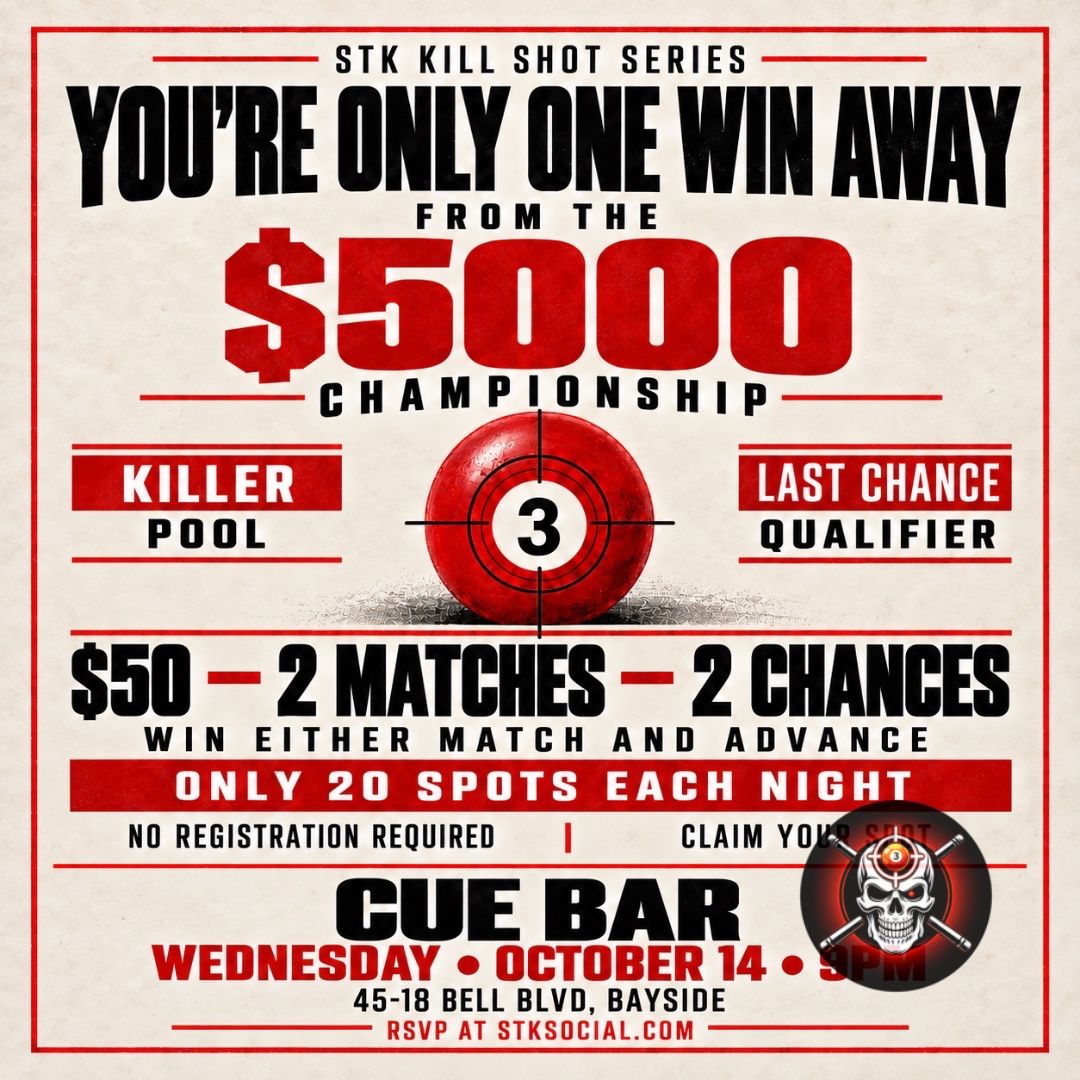
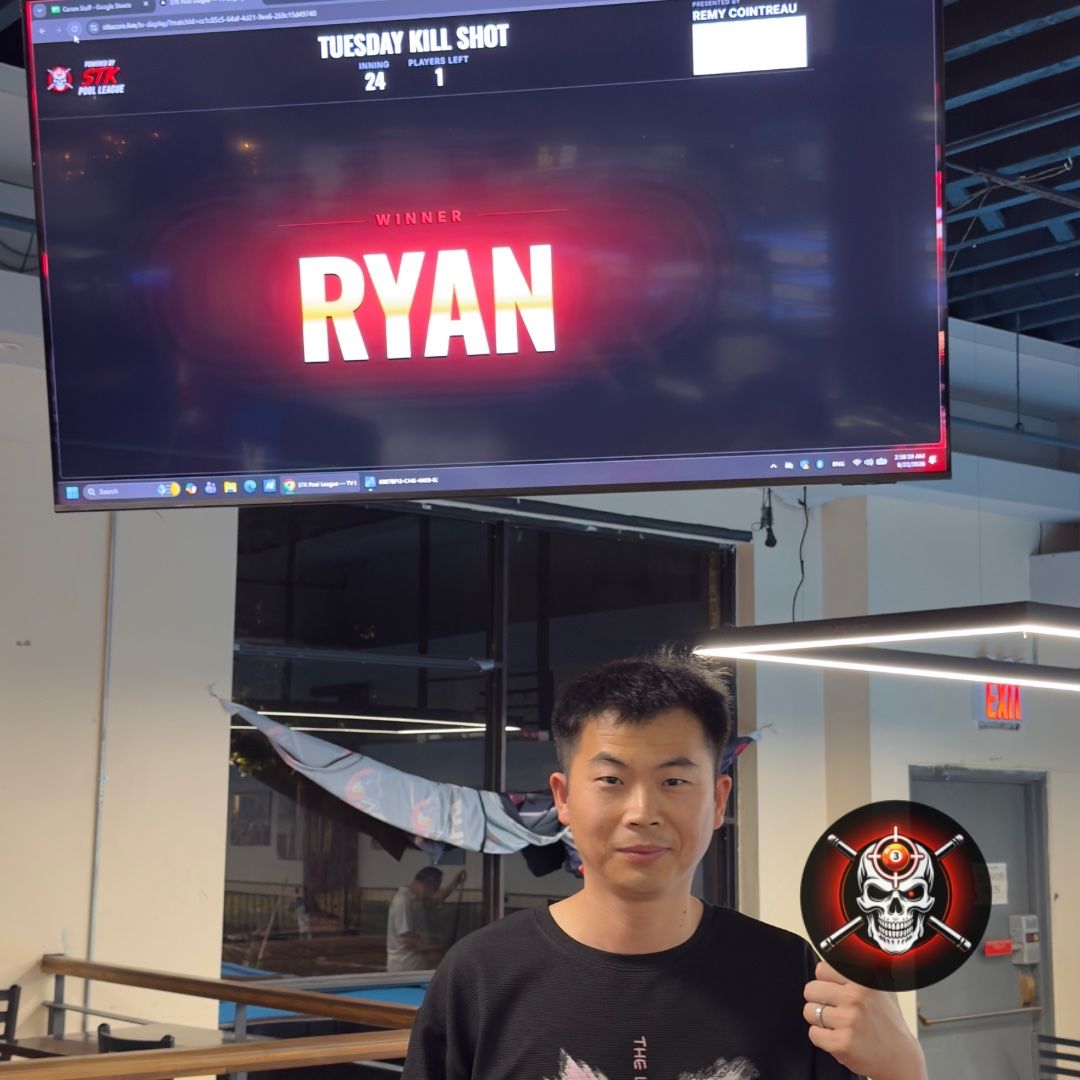
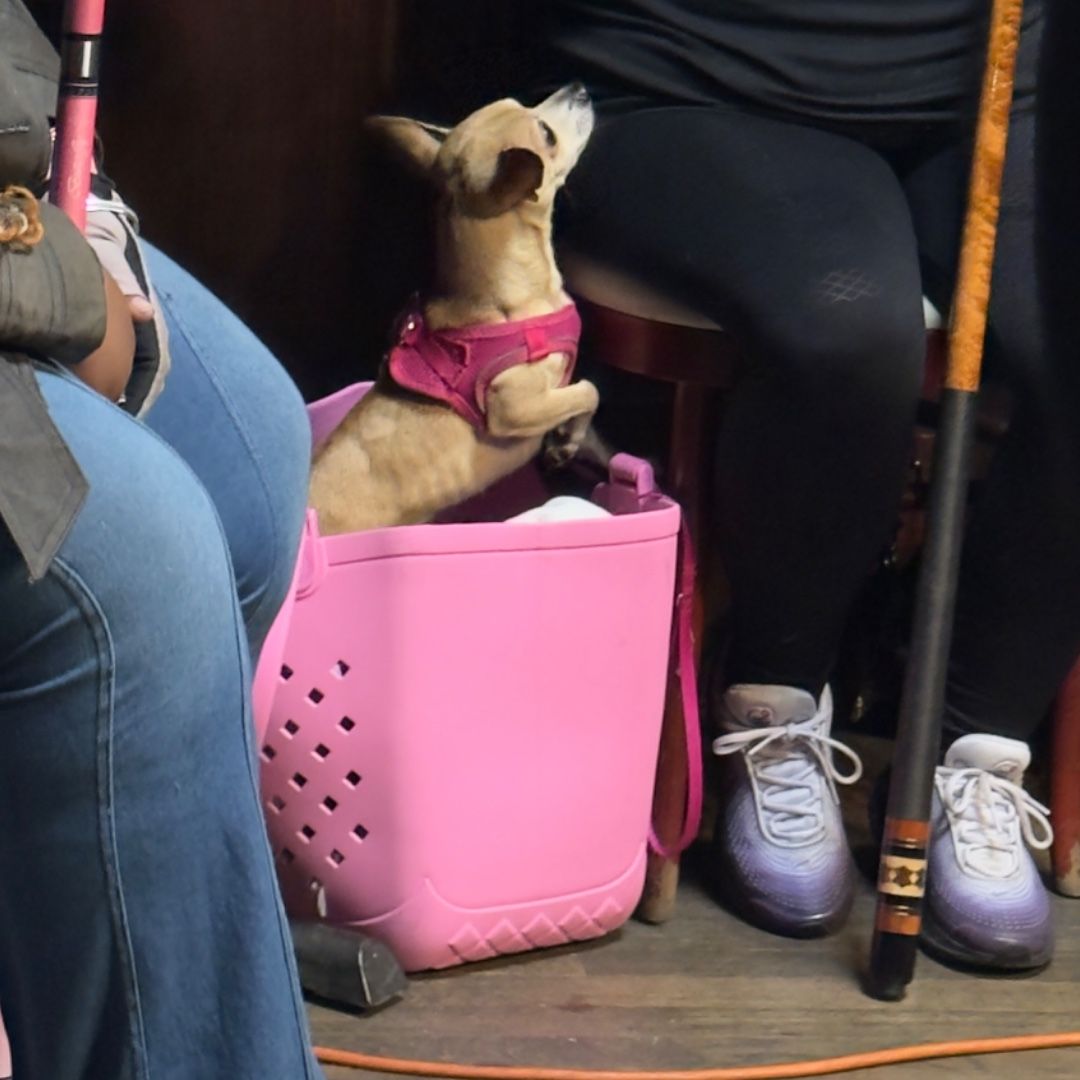
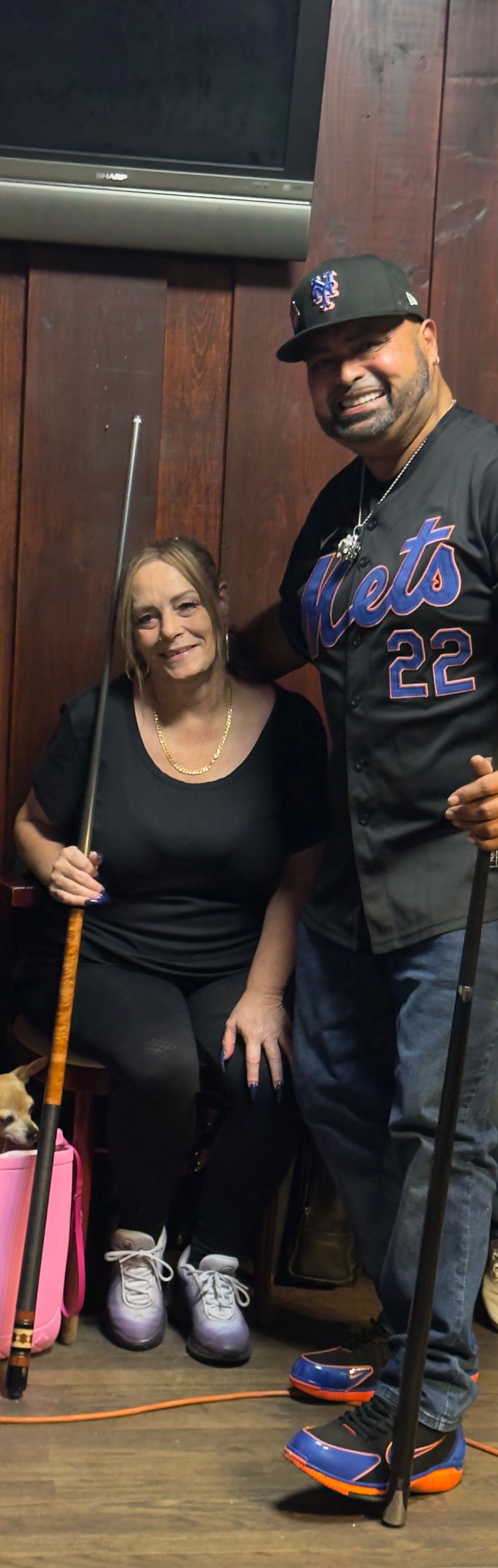
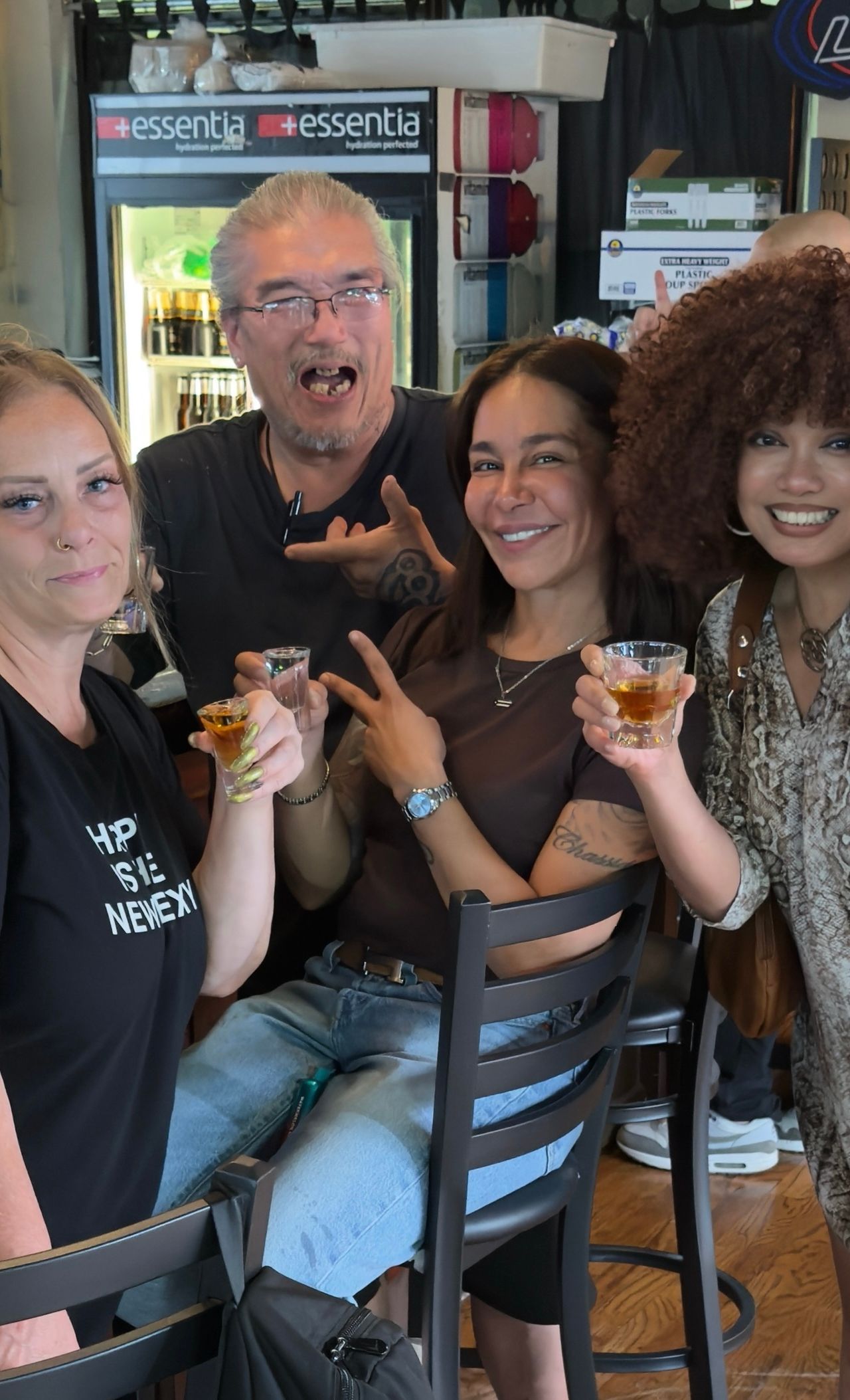
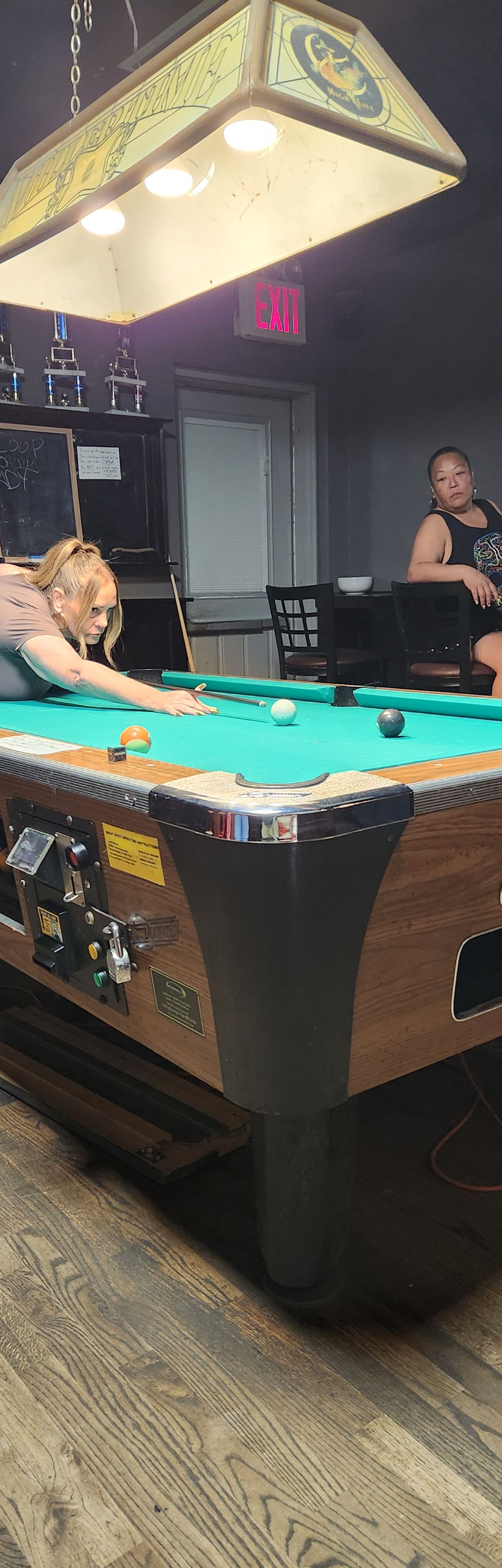
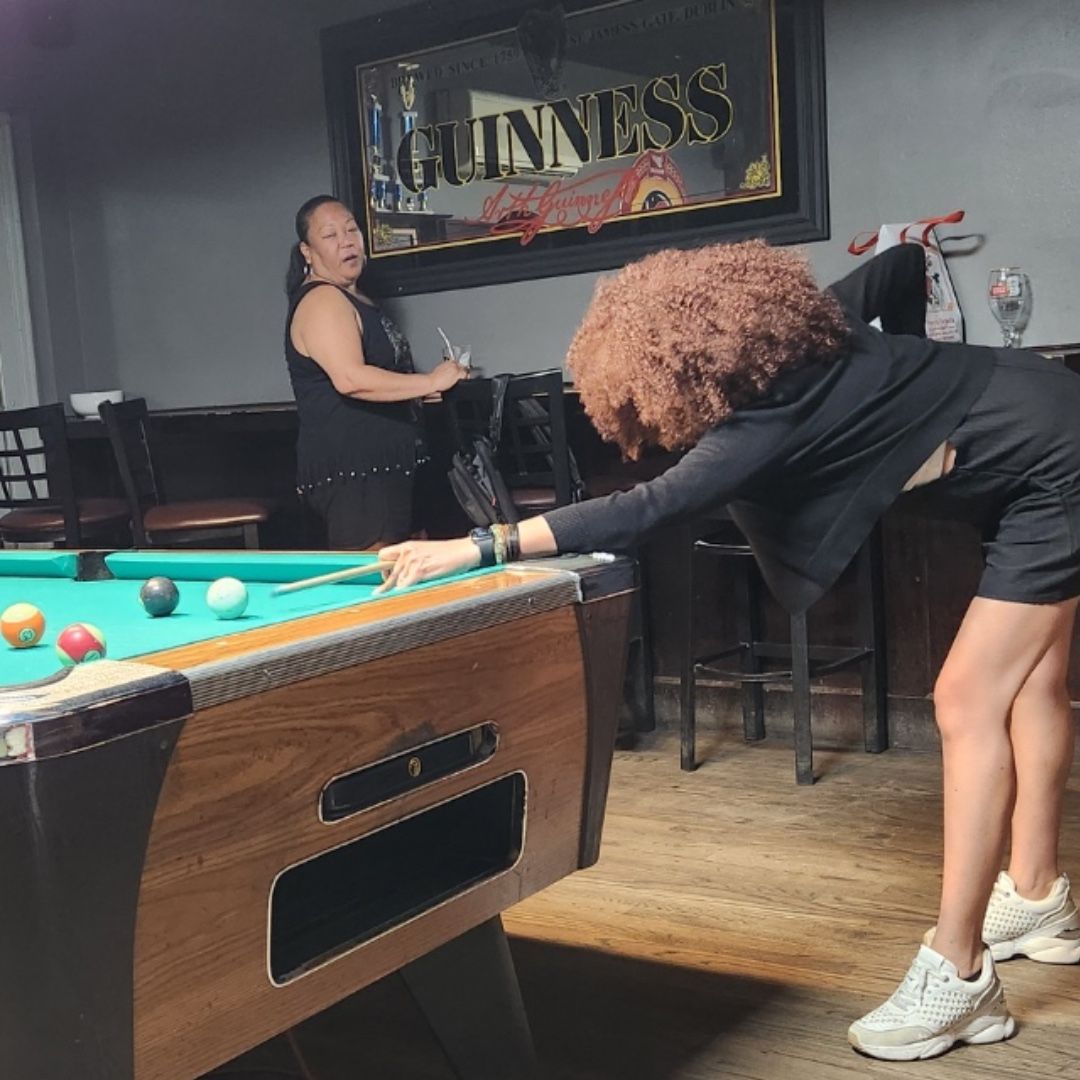
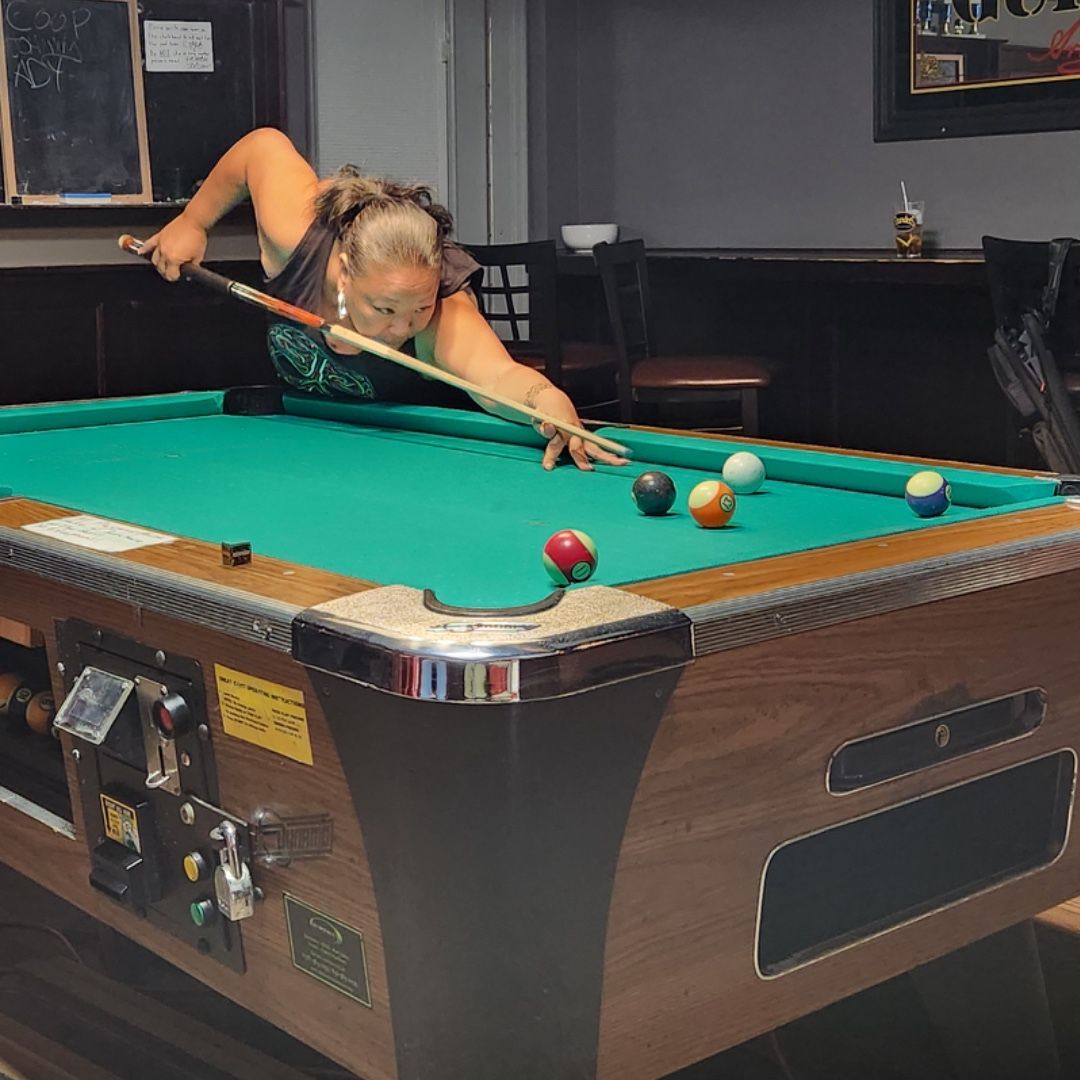
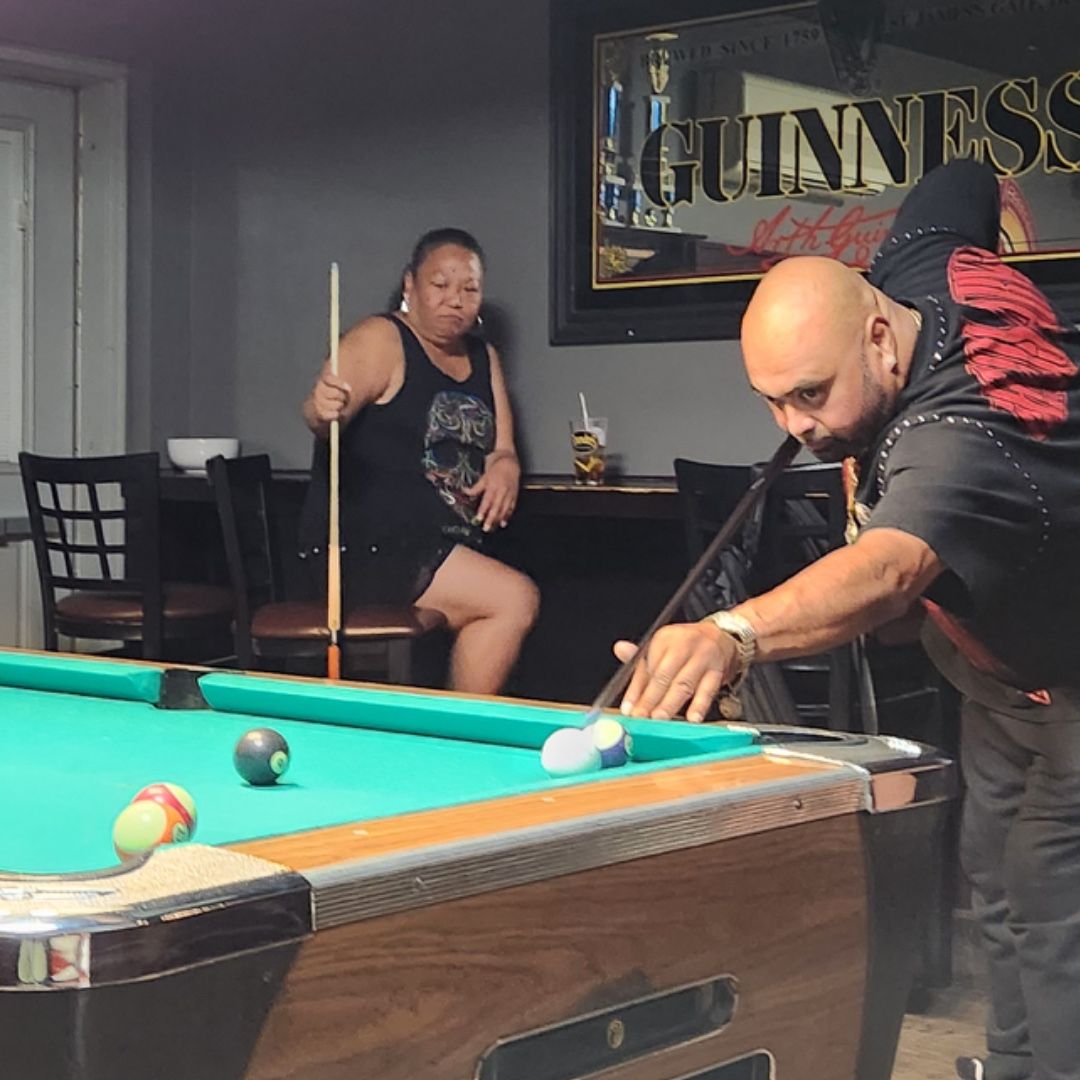
He won on his first try! Congrats on qualifying for the championship, Ryan!
STK
STK
Sep 21
STK Carom Cafe & Billiards Monday Recap
Match complete / Winners circle
ROOM CONQUERED. TICKET PUNCHED.
RYAN
Bounty
Carom Cafe & Billiards
Championship qualifier
W
Bounty bonus
NEIL TOOK OUT DARWIN.
+1 LIFE
Previous winner bounty · +1 regular-match credit
Bounty bonus
RYAN TOOK OUT NEILLE.
+1 LIFE
Host bounty · +1 regular-match credit
Bounty bonus
RYAN TOOK OUT NEIL.
+1 LIFE
Previous winner bounty · +1 regular-match credit
Bounty bonus
RYAN TOOK OUT DUC L.
+1 LIFE
Previous winner bounty · +1 regular-match credit
1 / 5
STK
STK
Sep 20
STK Globe Tavern Sunday Recap
Match complete / Winners circle
ROOM CONQUERED. TICKET PUNCHED.
ED S.
Bounty
The Globe Tavern
Championship qualifier
W
Match complete / Winners circle
ROOM CONQUERED. TICKET PUNCHED.
NEILLE
Bounty
The Globe Tavern
Championship qualifier · +1 Championship life
W
Bounty bonus
ED S. TOOK OUT MILLIE P.
+1 LIFE
Previous winner bounty · +1 regular-match credit
Bounty bonus
ED S. TOOK OUT NEILLE.
+1 LIFE
Host bounty · +1 regular-match credit
Bounty bonus
ED S. TOOK OUT DILLY.
+1 LIFE
Previous winner bounty · +1 regular-match credit
Bounty bonus
NEILLE TOOK OUT ED S.
+1 LIFE
Previous winner bounty · +1 regular-match credit
Bounty bonus
NEILLE TOOK OUT MILLIE P.
+1 LIFE
Previous winner bounty · +1 regular-match credit
Bounty bonus
DEBORAH B. TOOK OUT DILLY.
+1 LIFE
Previous winner bounty · +1 regular-match credit
1 / 10
STK
STK
Sep 17
STK Carom Cafe & Billiards Thursday Recap
Match complete / Winners circle
ROOM CONQUERED. TICKET PUNCHED.
NEIL
Bounty
Carom Cafe & Billiards
Championship qualifier
W
Bounty bonus
NEILLE TOOK OUT DARWIN.
+1 LIFE
Previous winner bounty · +1 regular-match credit
Bounty bonus
DUC L. TOOK OUT MHET V.
+1 LIFE
Previous winner bounty · +1 regular-match credit
Bounty bonus
DUC L. TOOK OUT NEILLE.
+1 LIFE
Host bounty · +1 regular-match credit
Bounty bonus
NEIL TOOK OUT DUC L.
+1 LIFE
Previous winner bounty · +1 regular-match credit
1 / 5
NC
Neille C.
Sep 16, 9:54 AM
Who's coming to play STK at Carom on Thursday?
STK
STK
Sep 14
STK Carom Cafe & Billiards Monday Recap
Winners circle
DUC IS MAXED OUT.
+1 LIFE
Championship: 3 base + 2 bonus = 5 lives · Cap reached
STK
STK
League recap · Win 2
Uh-oh! Duc has an extra life in the championship! Two wins, a couple of matches apart.
Winners circle
UH-OH! DUC DID IT AGAIN.
+1 LIFE
Championship: 3 base + 1 bonus = 4 lives
STK
STK
League recap · Bounty claimed
Neille eliminated Duc between his two wins and earned a bounty bonus.
Bounty bonus
NEILLE TOOK OUT DUC.
+1 LIFE
+1 regular-match credit
M
Michelle
Sep 10, 4:00 AM
Who’s coming to the Globe Tavern on Sunday?
STK
STK
League recap · Win 1
Duc takes his first win and qualifies for the championship.
Winners circle
ROOM CONQUERED. TICKET PUNCHED.
Championship qualified · 3 base lives
STK
STK
Sep 7
STK Monday Recap
Match complete / Winners circle
ROOM CONQUERED. TICKET PUNCHED.
MIKE D.
Bounty
Championship qualifier
W
1 / 5
STK
STK
Sep 6
STK Globe Tavern Sunday Recap
Match complete / Winners circle
ROOM CONQUERED. TICKET PUNCHED.
SUZZIE
Bounty
Championship qualifier
W
Match complete / Winners circle
ROOM CONQUERED. TICKET PUNCHED.
CLAUDIO
Bounty
Championship qualifier
W
1 / 2
STK
STK
Sep 3
STK Carom Cafe & Billiards Thursday Recap
Match complete / Winners circle
ROOM CONQUERED. TICKET PUNCHED.
CARMINE
Bounty
Championship qualifier
W
STK
STK
Aug 30
STK Globe Tavern Sunday Recap
Match complete / Winners circle
ROOM CONQUERED. TICKET PUNCHED.
MILLIE
Bounty
Championship qualifier
W
Match complete / Winners circle
ROOM CONQUERED. TICKET PUNCHED.
MICHELLE
Bounty
Championship qualifier
W
Match complete / Winners circle
ROOM CONQUERED. TICKET PUNCHED.
DILLY
Bounty
Championship qualifier
W
1 / 7
Show up. Shoot your shot.
Find your room
All times New York
Show up. Shoot your shot.
Venues
STK venues
Rooms running STK now.
Pending activation
Hit 15 votes. Getting set up.
Nominated
Sorted by votes, highest first.
Special nights
Events
Add event
The last ones standing
Winners circle
Season prize pool
of the season goal
0%20%40%60%80%100%
Road to the championship
ONE WIN. YOU’RE IN.
Win a match and advance to the championship.
Bounty Eliminate a previous winner to earn an extra life while you’re still active.
D
Duc
Bounty
Thursday Night Kill Shot · Sep 11
10 points
2 wins · 4 championship lives
MD
Mike D.
Bounty
Monday Night Kill Shot · Sep 8
14 points
C
Claudio
Bounty
Sunday Night Kill Shot · Sep 7
20 points
S
Suzzie
Bounty
Sunday Night Kill Shot · Sep 6
19 points
C
Carmine
Bounty
Thursday Night Kill Shot · Sep 4
15 points
D
Duke
Bounty
Friday Night Killer · Sep 1
12 points
D
Dilly
Bounty
Friday Night Killer · Aug 30
9 points
M
Michelle
Bounty
Friday Night Killer · Aug 30
11 points
M
Millie
Bounty
Friday Night Killer · Aug 30
14 points
M
Mhet
Bounty
Friday Night Killer · Aug 28
14 points
N
Neille
Bounty
Friday Night Killer · Aug 24
20 points
D
Dominic
Bounty
Friday Night Killer · Aug 24
16 points
K
Kool-Aid
Bounty
Friday Night Kill Shot · Aug 22
14 points
L
Leon
Bounty
Friday Night Kill Shot · Aug 21
10 points
D
Darwin
Bounty
Thursday Kill Shot · Aug 21
15 points
J
Jesus
Bounty
Friday Night Kill Shot · Aug 20
6 points
Know the game
Rules of the room
Watch: How to get on the STK Roster
STK Kill Shot Rules
Everyone plays at once. Players shoot in order. Player order is shuffled before the match starts. You get one shot per turn. All you have to do is make a ball - slop counts. If you miss, scratch, or foul, you get a strike. Reach your strike limit and you're eliminated.
Everyone starts the game with a 3-strike limit. In this series, you can purchase up to 2 more strikes for $5 each.
Pot a ball — no strike, next player shoots
Miss, scratch, or foul — you take a strike
Once you hit your strike limit, you're eliminated.
Breaks
If you break dry, you may shoot again. If you pot at least one ball on the break, the next player shoots. Any 4 balls must make contact with a rail for the break to be legal.
Shot clock
There is a 60-second shot clock if you need coaching on a shot.
Additional shot clocks for players who repeatedly slow down play: 30 seconds to approach the table, 60 seconds to shoot.
Fouls
Only cue ball fouls are counted as strikes.
An object ball that comes off the table also results in a strike and remains off the table.
Conduct
Banter is welcomed. Rudeness is never tolerated.
Earn Extra Lives
Refer a new player who registers, make two food or beverage orders during a match, or eliminate Neille or any previous Kill Shot winner to earn an extra life. But if you are eliminated before one of the players with a bounty is eliminated, you do not receive an extra life. You must still be active on the scoreboard to receive the extra life bounty.
These lives are added to your player account and may be saved or used during any regular Kill Shot Series match.
Extra lives earned through referrals, purchases, or bounties cannot be used at the Championship. Championship extra lives can only be earned by winning qualifying matches.
Entry Fee
$25 entry fee per match
Player Incentives
Refer new players: earn extra lives to use in any regular series match of your choosing.
Eliminate Neille: earn a bounty extra life.
Eliminate a previous match winner: earn a bounty extra life.
Earn a bonus life for placing two food or beverage orders per match in one night. If there are multiple matches, there are multiple opportunities to earn lives.
Win a regular match: qualify for the $5000 Championship. Win multiple matches, earn Championship lives (max 2 bonus, 5 lives total).
Championship lives can only be earned by winning matches. Referral, purchase, bounty rewards cannot create Championship lives.
Last player standing wins.
Your place in the league
Player profile
Grow the league
Invite friends
Send a private link. Invite friends to THE pool party
AdminTribes & roles0
Tribes
AdminVenues0
Ranked by votes. Pending rooms are ready to activate.
AdminReported messages0
Only reported messages show here — never a full chat.
Admin
Top 8
Controls the Player Top 8 and Venue Top 8 blocks on the feed. Hidden from every player until this is turned on.
Status: Off — hidden from players
Status: Off — hidden from players
Update your details
Edit profile
Profile photo
Before you chalk up
Frequently asked questions
First time here?
Do I have to be good at pool?
No. You get one shot per turn, and any pocketed ball counts—even slop. You’re here to play, meet people, and try to be the last one standing.
How does a match work?
Player order is shuffled before the match. Make a ball and your turn ends. Miss, scratch, or foul and you take a strike. Reach your strike limit and you’re eliminated. The last player standing wins.
How do I find a match and RSVP?
Open Matches, choose your night, and RSVP. RSVPs are for registered players and close one hour before the match starts.
What does it cost?
The current series rules list $25 entry fee per match.
How do I earn extra lives?
Bring a new player who registers, make two food or beverage orders during a match, or collect a bounty. Your profile keeps a record of earned and used regular-match credits.
What does the bounty icon mean?
Every previous Kill Shot winner is a bounty target. Neille is a bounty target too. Eliminate a target while you’re still active to earn an extra life. The next-game bounty board shows attending targets; seeded entries are marked until attendance is confirmed.
How do I qualify for the championship?
Win a regular match. A second win earns one extra championship life; a third earns another. Championship lives are capped at five: three base lives plus two bonus lives.
Can I bring my regular extra-life credits to the championship?
No. Referral, bar-purchase, and bounty credits are for regular series matches. Only qualifying match wins earn championship bonus lives.
Where do photos and match results appear?
Photos you post appear in the feed with an STK watermark. Winner cards celebrate match results, and reward announcements explain who earned an extra life and how.
How do I report a wrong stat or suggest something?
Use the feedback form. For a stats correction, include the player, match, date, and what needs fixing.
Official
October 28, 2026 · 6 min read
ADHD
Does ADHD Hurt or Help Your Game? What Research Says
Research finds small differences on some attention tests, and exercise may help. Here is what to try at your next match.
8.4% of Major League Baseball players received a Therapeutic Use Exemption for an ADHD stimulant, according to a report on a 2019 review of ADHD in elite athletes. The figure surprises people who picture ADHD as a barrier to sport. ADHD is common.
The research gives a plain thesis: ADHD is neither a handicap nor a secret weapon at the table. It carries small, measurable costs on some attention tests, and exercise has helped children and teenagers with ADHD on tests of attention and self-control. By the end of this article, you will know what the studies found, how strong they are, and which routines you can try, with or without ADHD.
The short answer: ADHD may affect about 7 to 8 percent of student and elite athletes, and the studies reviewed find only small differences on attention-related tests. In children and teenagers with ADHD, exercise improved executive functions, the mental skills that control attention. Research cannot yet say how ADHD changes a pool match. A professional should handle diagnosis and treatment.
How common is ADHD among athletes?
Researchers estimate that about 7 to 8 percent of student and elite athletes have ADHD, according to a 2019 narrative review in the British Journal of Sports Medicine. The authors suggest it may be more common in elite athletes than in the general population. Treat the number as an estimate, not a count.
Han, McDuff, Thompson, Hitchcock, Reardon, and Hainline wrote a narrative review, which means they summarized the literature without pooling the data statistically. That makes it a useful map and a weak measurement. They also note that symptoms may influence which sports people choose and how far they progress.
The National Institute of Mental Health describes ADHD as a neurodevelopmental disorder with three groups of behaviors: inattention, hyperactivity, and impulsivity. It adds that symptoms begin in childhood and usually continue into the teen years and adulthood.
Does ADHD make athletes perform worse?
Slightly, on some tests, and only in some studies. A 2018 systematic review in Sports Health found that athletes with ADHD generally scored lower on neurocognitive tests and reported more symptoms, but the authors called the score differences small. Those tests are not pool tables, so the review cannot say how ADHD changes a match.
Poysophon and Rao reviewed 17 studies, 10 cross-sectional and seven case-control. Their strongest finding was a link, not a cause: ADHD was associated with lower neurocognitive scores, and most of the studies that looked at concussion found a higher risk in athletes with ADHD. Prevalence in the included studies ran from 4.2% to 8.1%.
The limits matter. Most diagnoses came from self-report or chart review, not from a clinical evaluation, and the authors say only two studies followed athletes forward in time. The review mainly concerns athletes aged 15 to 19. Read the review as a caution against big claims in either direction, not as proof that ADHD costs you games.
Can exercise sharpen attention for players with ADHD?
Probably yes, for children and teenagers. A 2023 network meta-analysis in Frontiers in Public Health found that physical exercise improved executive functions, the mental skills that control attention and impulses. The authors say the evidence quality is limited, and no adults were studied.
Zhu and colleagues included 59 studies in their review and pooled 44 of them, with 1,757 participants under 18. For executive functions, they analyzed 33 studies and 1,289 participants and found an overall effect of 1.15 standard deviations (95% confidence interval 0.83 to 1.46).
The finding most relevant to a bar-league player is about the type of activity. Open-skill activities, which demand reactions to a changing environment, ranked first for inhibitory control, the ability to hold back an impulse. Closed-skill activities dominated by aerobic exercise ranked first for reducing inattention. The study did not test pool, so the safest reading is that a short warm-up with movement before a match is worth trying. That is an inference, not a result.
The authors say the findings need cautious interpretation because many included studies were of limited quality.
Do ADHD medications make athletes better?
Possibly, but nobody knows how much. A 2022 meta-analysis in Sports Medicine Open found that six of nine small studies, with 157 participants in total, reported better athletic performance with ADHD medications. The two studies that could be pooled gave an inconclusive result. Medication decisions belong to a doctor.
Berezanskaya and colleagues found that methylphenidate and amphetamine were most consistently linked to better performance. They also flagged serious limits: small samples, mostly male participants, mostly single-dose experiments, and several studies with an unclear risk of bias. The authors concluded that there was "no conclusive effect" on exercise performance or power output.
The practical point for a player is modest. Medicine is a medical question about a diagnosed condition, and the research does not offer a performance shortcut. If you suspect you have ADHD, or you are unhappy with your treatment, see a licensed professional. This article describes research and does not offer medical advice.
Try this at your next match
Write your pre-shot routine on a card. Make it three to five steps, such as chalk, look at the pocket, look at the cue ball, one breath, shoot. No source here tested routines, so treat it as an experiment.
Move for five minutes before you play. Walk briskly or do easy aerobic movement in the parking lot. The exercise evidence comes from children and teenagers, so treat this as an experiment and note how your first game feels.
Keep your hands and eyes busy between shots. Chalk the cue, pick a spot on the rack, or study the next two balls.
Use one reset cue after a miss. Choose a single action, such as wiping your palm on your jeans, that means the last shot is over. Do it every time.
Tell your captain what helps. If a quiet corner, a short break, or a heads-up before your turn keeps you sharp, ask for it.
Weekly email
Behind the Ball
A free weekly email: a recap of our new articles, tournaments coming up (STK’s and others’) and the pool news we shared.
Yes. The research shows only small differences on some attention tests, and none of the studies measured pool performance. Skill comes from practice.
Is ADHD more common in athletes than in other people?
Possibly. A 2019 review estimates about 7 to 8 percent of student and elite athletes have it and suggests it may be more common in elite athletes than in the general population. A 2018 systematic review found 4.2% to 8.1% in the studies it included. These are estimates, not counts.
Does exercise treat ADHD?
Exercise improved executive functions and symptoms in a 2023 network meta-analysis of studies on children and adolescents. The authors urge caution, and exercise is not a substitute for professional care.
Should I take medication to play better?
No article can answer that for you. The 2022 meta-analysis found inconclusive pooled results and small studies, so talk to a doctor about your own treatment.
How do I find out if I have ADHD?
See a licensed health professional. Only a clinical evaluation can diagnose ADHD, and an article or a quiz cannot.