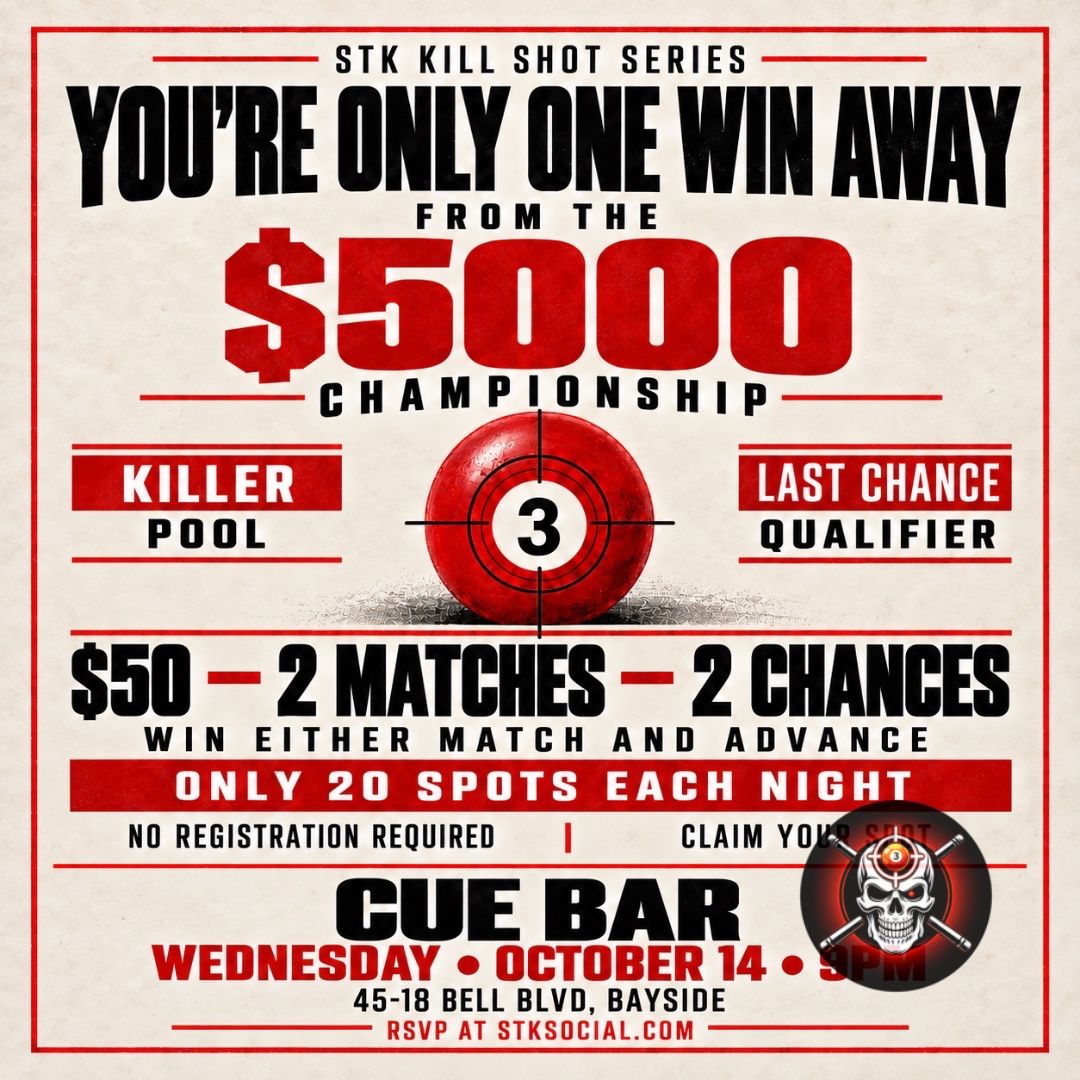
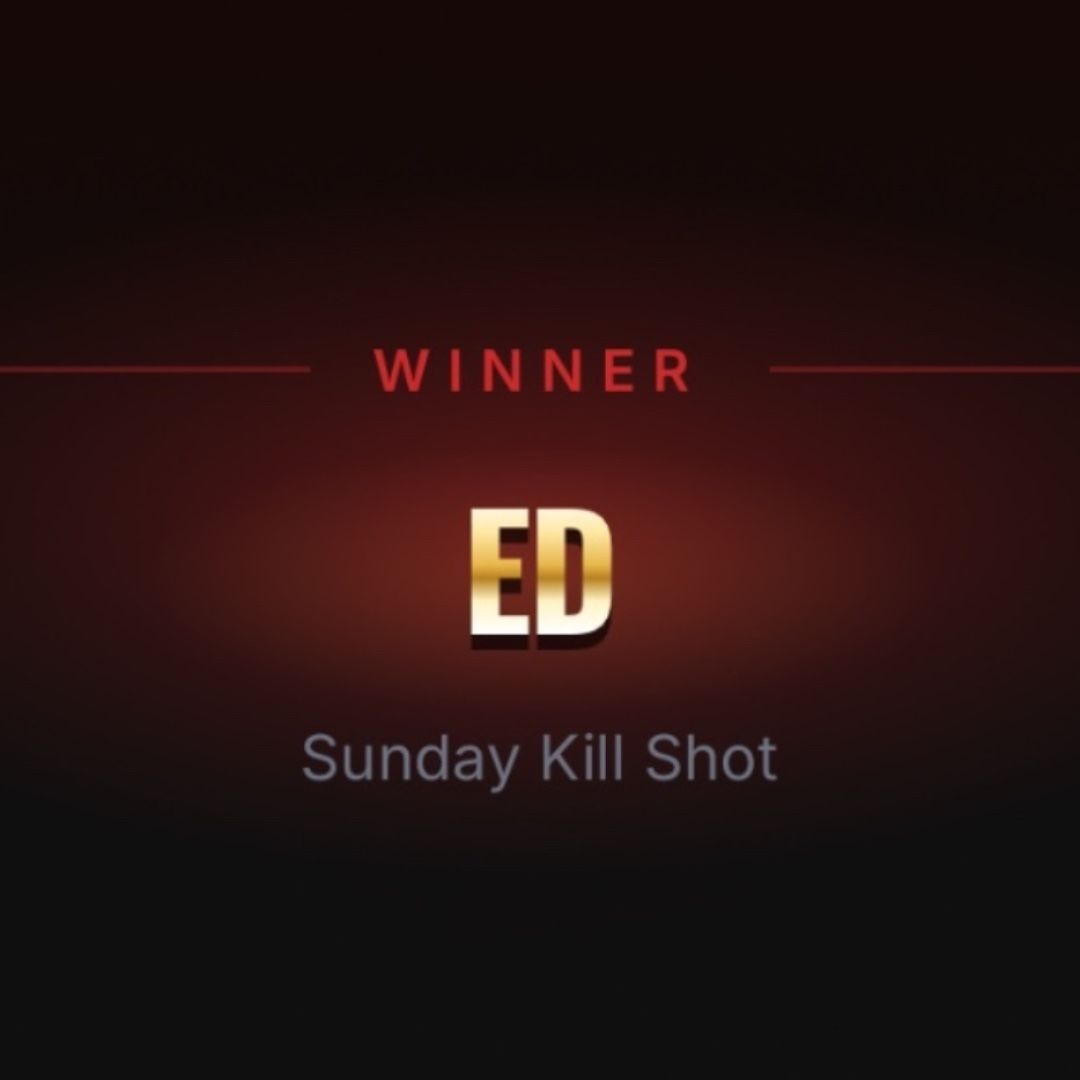
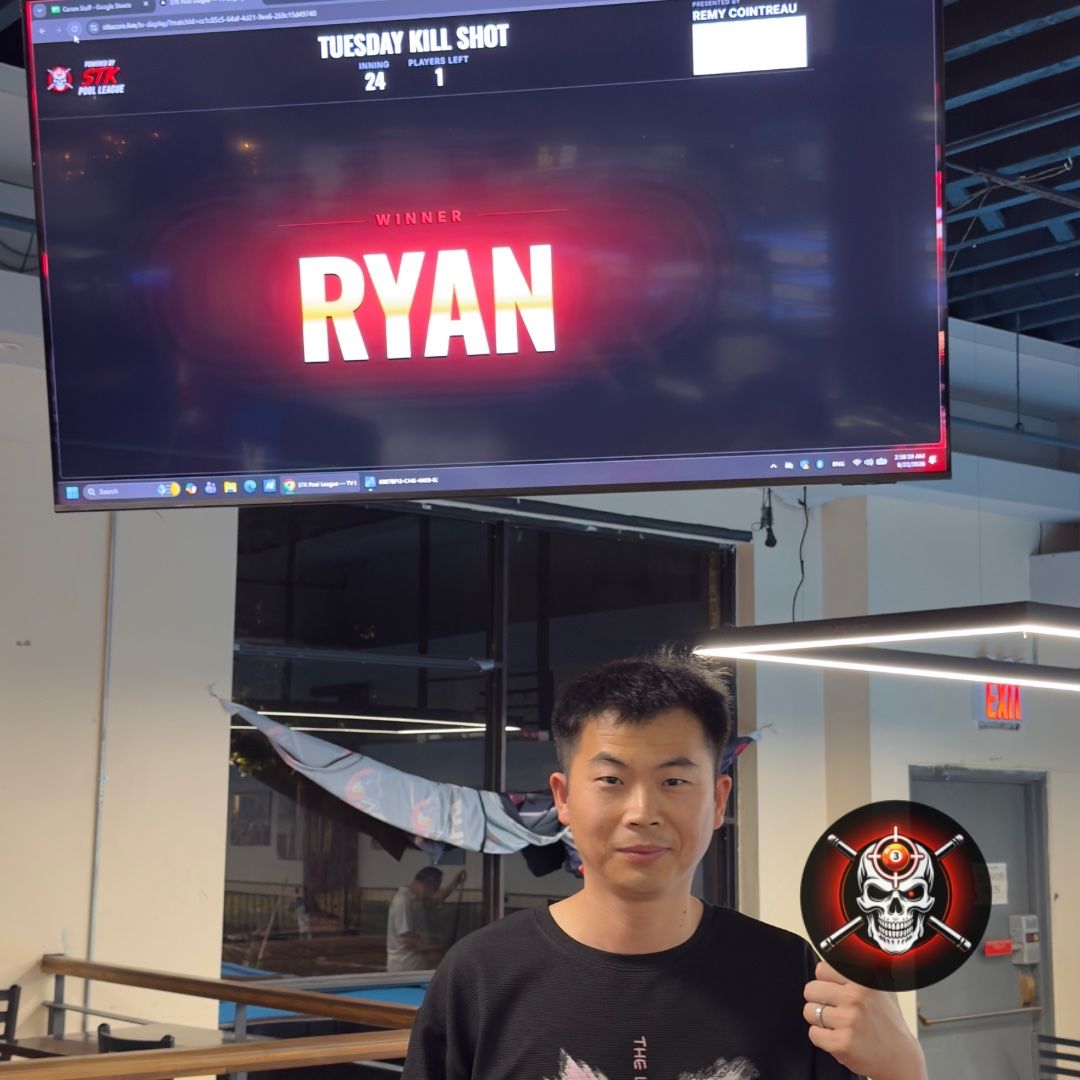
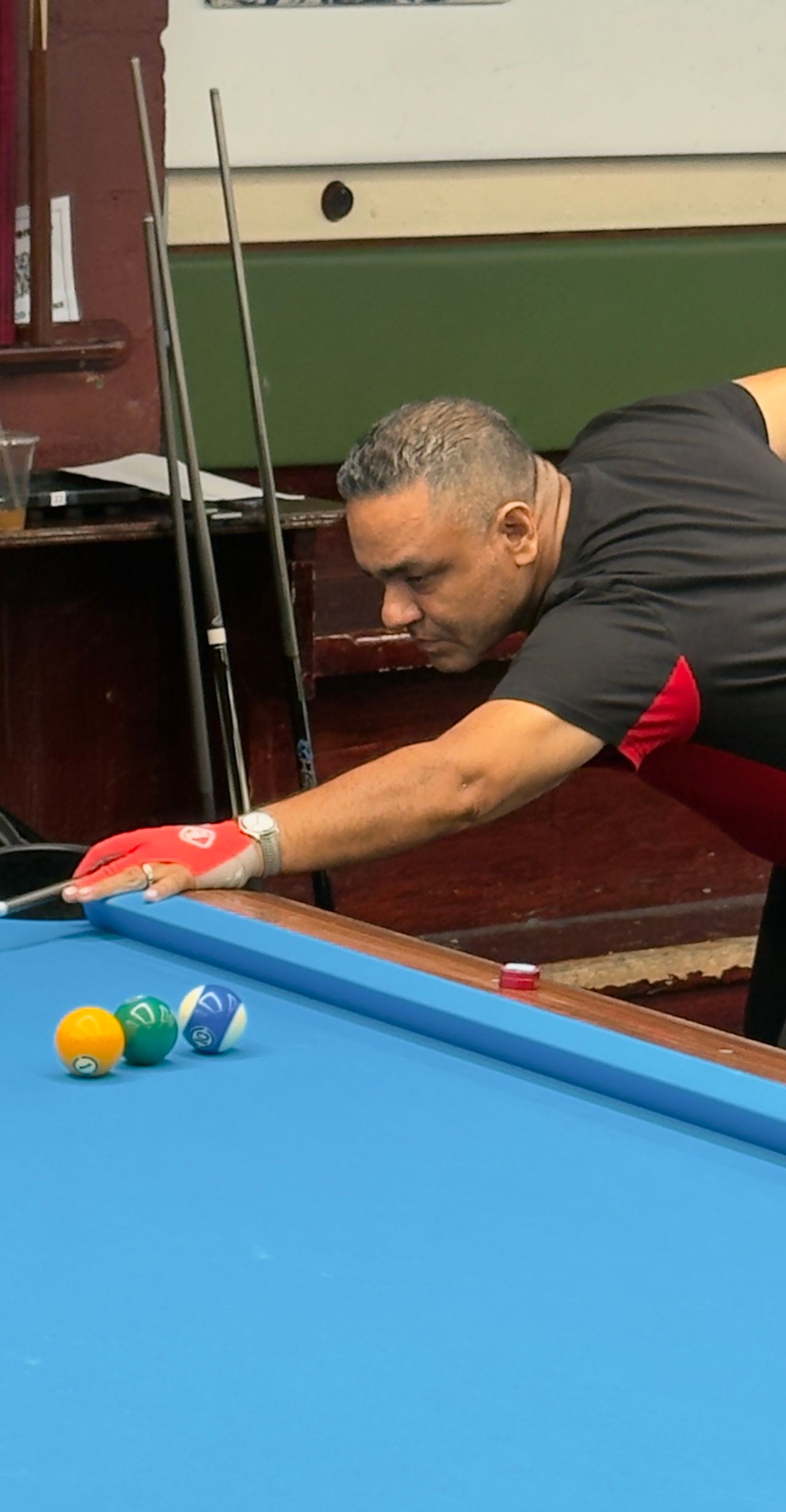
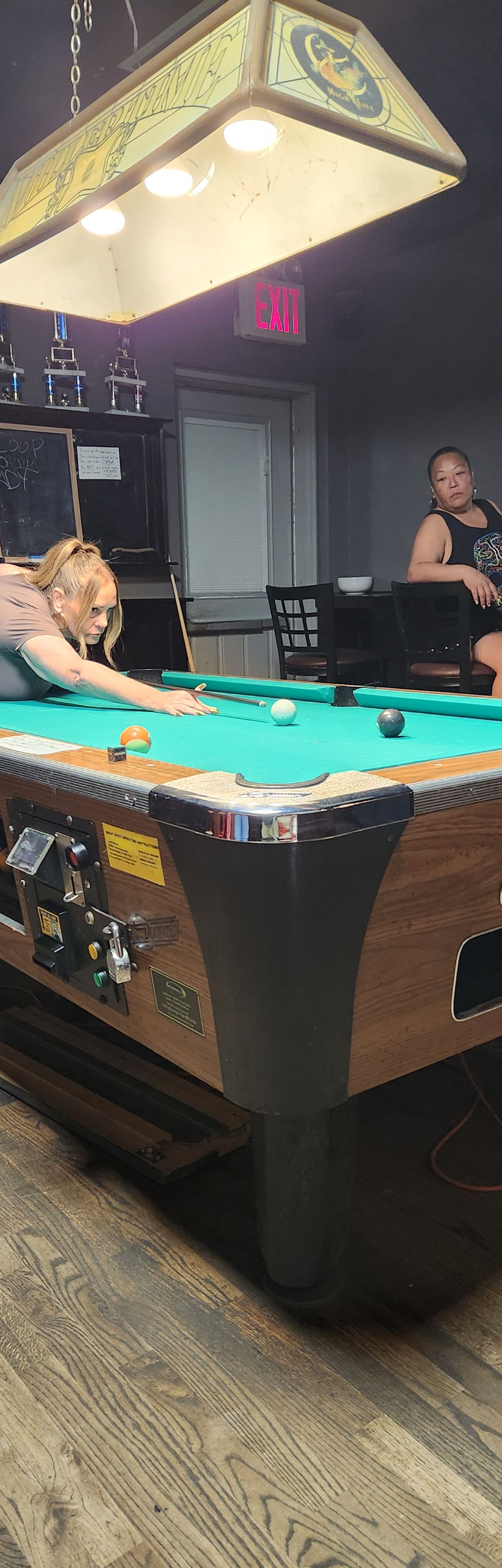
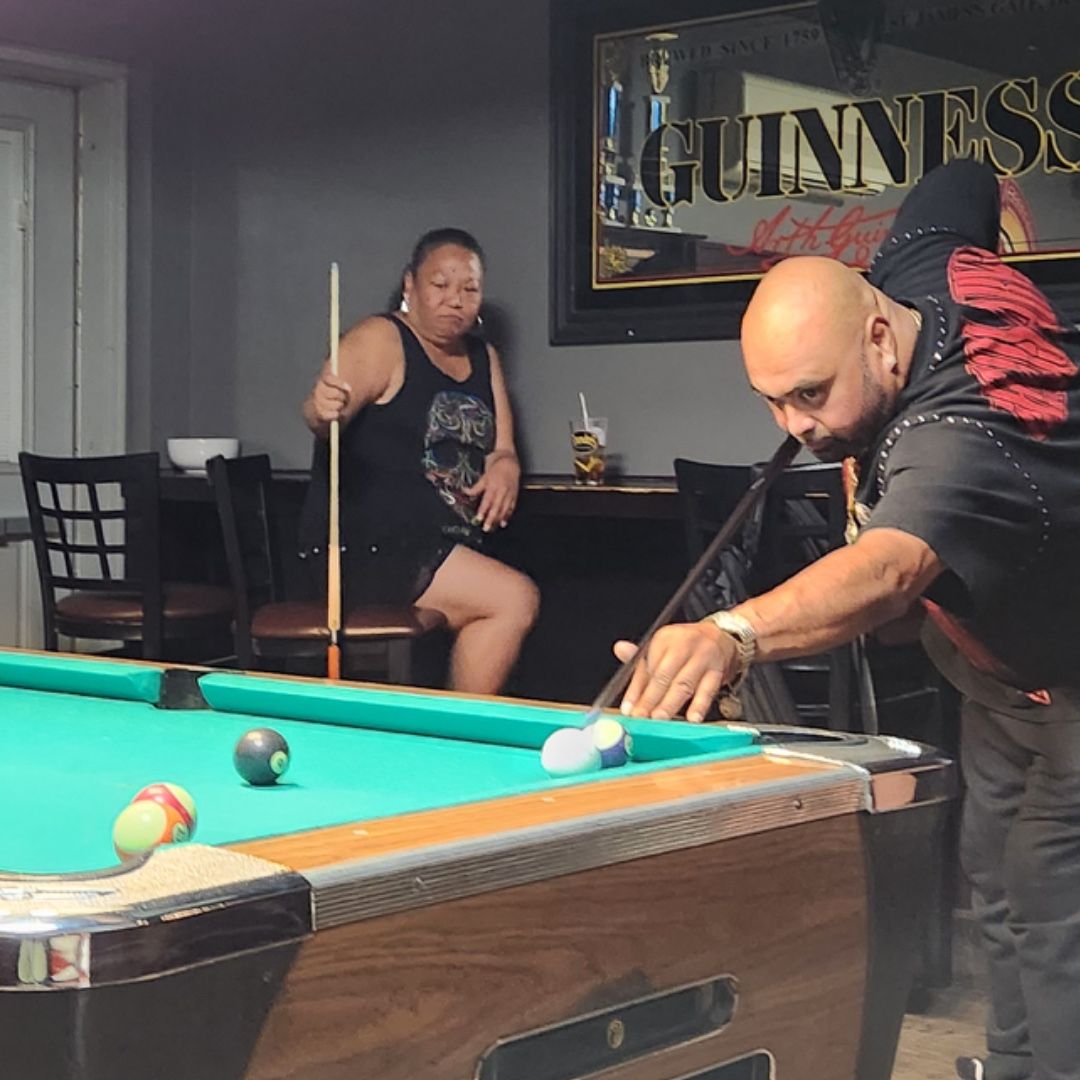
He won on his first try! Congrats on qualifying for the championship, Ryan!
STK
STK
Sep 21
STK Carom Cafe & Billiards Monday Recap
Match complete / Winners circle
ROOM CONQUERED. TICKET PUNCHED.
RYAN
Bounty
Carom Cafe & Billiards
Championship qualifier
W
Bounty bonus
NEIL TOOK OUT DARWIN.
+1 LIFE
Previous winner bounty · +1 regular-match credit
Bounty bonus
RYAN TOOK OUT NEILLE.
+1 LIFE
Host bounty · +1 regular-match credit
Bounty bonus
RYAN TOOK OUT NEIL.
+1 LIFE
Previous winner bounty · +1 regular-match credit
Bounty bonus
RYAN TOOK OUT DUC L.
+1 LIFE
Previous winner bounty · +1 regular-match credit
1 / 5
STK
STK
Sep 20
STK Globe Tavern Sunday Recap
Match complete / Winners circle
ROOM CONQUERED. TICKET PUNCHED.
ED S.
Bounty
The Globe Tavern
Championship qualifier
W
Match complete / Winners circle
ROOM CONQUERED. TICKET PUNCHED.
NEILLE
Bounty
The Globe Tavern
Championship qualifier · +1 Championship life
W
Bounty bonus
ED S. TOOK OUT MILLIE P.
+1 LIFE
Previous winner bounty · +1 regular-match credit
Bounty bonus
ED S. TOOK OUT NEILLE.
+1 LIFE
Host bounty · +1 regular-match credit
Bounty bonus
ED S. TOOK OUT DILLY.
+1 LIFE
Previous winner bounty · +1 regular-match credit
Bounty bonus
NEILLE TOOK OUT ED S.
+1 LIFE
Previous winner bounty · +1 regular-match credit
Bounty bonus
NEILLE TOOK OUT MILLIE P.
+1 LIFE
Previous winner bounty · +1 regular-match credit
Bounty bonus
DEBORAH B. TOOK OUT DILLY.
+1 LIFE
Previous winner bounty · +1 regular-match credit
1 / 10
STK
STK
Sep 17
STK Carom Cafe & Billiards Thursday Recap
Match complete / Winners circle
ROOM CONQUERED. TICKET PUNCHED.
NEIL
Bounty
Carom Cafe & Billiards
Championship qualifier
W
Bounty bonus
NEILLE TOOK OUT DARWIN.
+1 LIFE
Previous winner bounty · +1 regular-match credit
Bounty bonus
DUC L. TOOK OUT MHET V.
+1 LIFE
Previous winner bounty · +1 regular-match credit
Bounty bonus
DUC L. TOOK OUT NEILLE.
+1 LIFE
Host bounty · +1 regular-match credit
Bounty bonus
NEIL TOOK OUT DUC L.
+1 LIFE
Previous winner bounty · +1 regular-match credit
1 / 5
NC
Neille C.
Sep 16, 9:54 AM
Who's coming to play STK at Carom on Thursday?
STK
STK
Sep 14
STK Carom Cafe & Billiards Monday Recap
Winners circle
DUC IS MAXED OUT.
+1 LIFE
Championship: 3 base + 2 bonus = 5 lives · Cap reached
STK
STK
League recap · Win 2
Uh-oh! Duc has an extra life in the championship! Two wins, a couple of matches apart.
Winners circle
UH-OH! DUC DID IT AGAIN.
+1 LIFE
Championship: 3 base + 1 bonus = 4 lives
STK
STK
League recap · Bounty claimed
Neille eliminated Duc between his two wins and earned a bounty bonus.
Bounty bonus
NEILLE TOOK OUT DUC.
+1 LIFE
+1 regular-match credit
M
Michelle
Sep 10, 4:00 AM
Who’s coming to the Globe Tavern on Sunday?
STK
STK
League recap · Win 1
Duc takes his first win and qualifies for the championship.
Winners circle
ROOM CONQUERED. TICKET PUNCHED.
Championship qualified · 3 base lives
STK
STK
Sep 7
STK Monday Recap
Match complete / Winners circle
ROOM CONQUERED. TICKET PUNCHED.
MIKE D.
Bounty
Championship qualifier
W
1 / 5
STK
STK
Sep 6
STK Globe Tavern Sunday Recap
Match complete / Winners circle
ROOM CONQUERED. TICKET PUNCHED.
SUZZIE
Bounty
Championship qualifier
W
Match complete / Winners circle
ROOM CONQUERED. TICKET PUNCHED.
CLAUDIO
Bounty
Championship qualifier
W
1 / 2
STK
STK
Sep 3
STK Carom Cafe & Billiards Thursday Recap
Match complete / Winners circle
ROOM CONQUERED. TICKET PUNCHED.
CARMINE
Bounty
Championship qualifier
W
STK
STK
Aug 30
STK Globe Tavern Sunday Recap
Match complete / Winners circle
ROOM CONQUERED. TICKET PUNCHED.
MILLIE
Bounty
Championship qualifier
W
Match complete / Winners circle
ROOM CONQUERED. TICKET PUNCHED.
MICHELLE
Bounty
Championship qualifier
W
Match complete / Winners circle
ROOM CONQUERED. TICKET PUNCHED.
DILLY
Bounty
Championship qualifier
W
1 / 7
Show up. Shoot your shot.
Find your room
All times New York
Show up. Shoot your shot.
Venues
STK venues
Rooms running STK now.
Pending activation
Hit 15 votes. Getting set up.
Nominated
Sorted by votes, highest first.
Special nights
Events
Add event
The last ones standing
Winners circle
Season prize pool
of the season goal
0%20%40%60%80%100%
Road to the championship
ONE WIN. YOU’RE IN.
Win a match and advance to the championship.
Bounty Eliminate a previous winner to earn an extra life while you’re still active.
D
Duc
Bounty
Thursday Night Kill Shot · Sep 11
10 points
2 wins · 4 championship lives
MD
Mike D.
Bounty
Monday Night Kill Shot · Sep 8
14 points
C
Claudio
Bounty
Sunday Night Kill Shot · Sep 7
20 points
S
Suzzie
Bounty
Sunday Night Kill Shot · Sep 6
19 points
C
Carmine
Bounty
Thursday Night Kill Shot · Sep 4
15 points
D
Duke
Bounty
Friday Night Killer · Sep 1
12 points
D
Dilly
Bounty
Friday Night Killer · Aug 30
9 points
M
Michelle
Bounty
Friday Night Killer · Aug 30
11 points
M
Millie
Bounty
Friday Night Killer · Aug 30
14 points
M
Mhet
Bounty
Friday Night Killer · Aug 28
14 points
N
Neille
Bounty
Friday Night Killer · Aug 24
20 points
D
Dominic
Bounty
Friday Night Killer · Aug 24
16 points
K
Kool-Aid
Bounty
Friday Night Kill Shot · Aug 22
14 points
L
Leon
Bounty
Friday Night Kill Shot · Aug 21
10 points
D
Darwin
Bounty
Thursday Kill Shot · Aug 21
15 points
J
Jesus
Bounty
Friday Night Kill Shot · Aug 20
6 points
Know the game
Rules of the room
Watch: How to get on the STK Roster
STK Kill Shot Rules
Everyone plays at once. Players shoot in order. Player order is shuffled before the match starts. You get one shot per turn. All you have to do is make a ball - slop counts. If you miss, scratch, or foul, you get a strike. Reach your strike limit and you're eliminated.
Everyone starts the game with a 3-strike limit. In this series, you can purchase up to 2 more strikes for $5 each.
Pot a ball — no strike, next player shoots
Miss, scratch, or foul — you take a strike
Once you hit your strike limit, you're eliminated.
Breaks
If you break dry, you may shoot again. If you pot at least one ball on the break, the next player shoots. Any 4 balls must make contact with a rail for the break to be legal.
Shot clock
There is a 60-second shot clock if you need coaching on a shot.
Additional shot clocks for players who repeatedly slow down play: 30 seconds to approach the table, 60 seconds to shoot.
Fouls
Only cue ball fouls are counted as strikes.
An object ball that comes off the table also results in a strike and remains off the table.
Conduct
Banter is welcomed. Rudeness is never tolerated.
Earn Extra Lives
Refer a new player who registers, make two food or beverage orders during a match, or eliminate Neille or any previous Kill Shot winner to earn an extra life. But if you are eliminated before one of the players with a bounty is eliminated, you do not receive an extra life. You must still be active on the scoreboard to receive the extra life bounty.
These lives are added to your player account and may be saved or used during any regular Kill Shot Series match.
Extra lives earned through referrals, purchases, or bounties cannot be used at the Championship. Championship extra lives can only be earned by winning qualifying matches.
Entry Fee
$25 entry fee per match
Player Incentives
Refer new players: earn extra lives to use in any regular series match of your choosing.
Eliminate Neille: earn a bounty extra life.
Eliminate a previous match winner: earn a bounty extra life.
Earn a bonus life for placing two food or beverage orders per match in one night. If there are multiple matches, there are multiple opportunities to earn lives.
Win a regular match: qualify for the $5000 Championship. Win multiple matches, earn Championship lives (max 2 bonus, 5 lives total).
Championship lives can only be earned by winning matches. Referral, purchase, bounty rewards cannot create Championship lives.
Last player standing wins.
Your place in the league
Player profile
Grow the league
Invite friends
Send a private link. Invite friends to THE pool party
AdminTribes & roles0
Tribes
AdminVenues0
Ranked by votes. Pending rooms are ready to activate.
AdminReported messages0
Only reported messages show here — never a full chat.
Admin
Top 8
Controls the Player Top 8 and Venue Top 8 blocks on the feed. Hidden from every player until this is turned on.
Status: Off — hidden from players
Status: Off — hidden from players
Update your details
Edit profile
Profile photo
Before you chalk up
Frequently asked questions
First time here?
Do I have to be good at pool?
No. You get one shot per turn, and any pocketed ball counts—even slop. You’re here to play, meet people, and try to be the last one standing.
How does a match work?
Player order is shuffled before the match. Make a ball and your turn ends. Miss, scratch, or foul and you take a strike. Reach your strike limit and you’re eliminated. The last player standing wins.
How do I find a match and RSVP?
Open Matches, choose your night, and RSVP. RSVPs are for registered players and close one hour before the match starts.
What does it cost?
The current series rules list $25 entry fee per match.
How do I earn extra lives?
Bring a new player who registers, make two food or beverage orders during a match, or collect a bounty. Your profile keeps a record of earned and used regular-match credits.
What does the bounty icon mean?
Every previous Kill Shot winner is a bounty target. Neille is a bounty target too. Eliminate a target while you’re still active to earn an extra life. The next-game bounty board shows attending targets; seeded entries are marked until attendance is confirmed.
How do I qualify for the championship?
Win a regular match. A second win earns one extra championship life; a third earns another. Championship lives are capped at five: three base lives plus two bonus lives.
Can I bring my regular extra-life credits to the championship?
No. Referral, bar-purchase, and bounty credits are for regular series matches. Only qualifying match wins earn championship bonus lives.
Where do photos and match results appear?
Photos you post appear in the feed with an STK watermark. Winner cards celebrate match results, and reward announcements explain who earned an extra life and how.
How do I report a wrong stat or suggest something?
Use the feedback form. For a stats correction, include the player, match, date, and what needs fixing.
Official
November 9, 2026 · 6 min read
Hot Hand
Is the Hot Hand Real? What Streak Research Says
Streaks in sport may be real: a 2018 reanalysis reversed the old hot hand fallacy finding, but the wider evidence is mixed.
Twenty-six Cornell basketball players each took 100 shots in a controlled test. Psychologists Thomas Gilovich, Robert Vallone, and Amos Tversky studied the results in 1985 and asked a simple question: does a made shot make the next one more likely? Their answer, that the "hot hand" is a cognitive illusion, became the accepted view of streaks. In 2018, two researchers found a flaw in how that test was scored.
The thesis is simple. Streaks in sport may be real, and researchers still disagree about how big they are. This article explains why the answer flipped, what is still uncertain, and how to treat a hot run at the table.
The short answer: is the hot hand real?
Possibly, and the effect may not be small. The 1985 study concluded streaks were an illusion, but a 2018 reanalysis found its method was biased against finding them and that, once corrected, the same data show a sizable effect. A 2013 review of 22 articles found no solid evidence of a general effect. We found no study of pool.
What did the original hot hand research find?
The 1985 study reported only a negligible difference, about three percentage points, in shooting after hits versus misses. Miller and Sanjurjo describe that controlled test as 26 players, 14 men and 12 women, with 100 shots each. Gilovich and colleagues concluded that people see patterns in random sequences, so fans and players believed in streaks that were not there.
For decades, that was the accepted view. Scientific American reports that Daniel Kahneman called it a "massive and widespread cognitive illusion," and the "hot hand fallacy" became the standard view. The takeaway was to doubt streaks, since runs of hits can arise from chance alone.
Why did a coin flip change the answer?
Because of a subtle selection effect. Miller and Sanjurjo (Econometrica, 2018) showed that the usual test, which collects every shot that follows a streak and checks how often it goes in, is biased downward. A fair coin makes the point: the expected share of heads on flips that follow heads is below one-half.
Their simplest example uses three flips. Averaged over the sequences in which a head is followed by another flip, the expected proportion of heads after a head is 5/12, about 42 percent, not 50 percent. The bias shrinks as sequences get longer, but they report it stays substantial at lengths common in real studies.
Scientific American gives the intuition. A run that ends in tails leaves fewer flips available to count than a run that continues in heads, so tails are over-represented among the flips you select. A fair shooter therefore looks slightly cold after hits when scored this way.
What happened when the Cornell data was corrected?
The correction reversed the finding. In their Scientific American piece, Miller and Sanjurjo write that the 1985 study reported a field goal percentage only three percentage points higher after streaks of makes. Once the bias is removed, they report it is 11 percentage points higher than chance would predict. Their preprint gives a figure of 13 points, so the two write-ups give different sizes.
They call that roughly the gap between an average NBA three-point shooter and the best, and they say the true effect may be larger because of measurement error. The preprint also reports that after correction 19 of 25 players shot better after streaks. Read that as one reanalysis of one small dataset, not a verdict.
Does the rest of the evidence agree?
Not clearly. Avugos and colleagues (Psychology of Sport and Exercise, 2013) pooled 22 articles across sports, with 56 effect sizes, and found an average effect of .02. They reported no solid evidence for a general hot hand. That review predates the 2018 correction.
Miller and Sanjurjo also state limits. Their bias calculation assumes each shooter has a fixed chance of success on every shot. They conclude the belief in the hot hand is not a cognitive illusion, but the preprint adds that it is perhaps even likely that players and coaches sometimes see a hot hand that is not there.
What does this mean for a pool player?
Treat a hot run as a feeling you may trust a little, not a forecast you must obey. We found no hot hand test on pool, and a rack involves planning shot to shot, so pool may differ from the controlled shooting test. The research cannot tell you your odds on the next ball.
The reanalysis turned on how short sequences behave, so small samples deserve caution. Judging yourself on a few shots can mislead you in either direction. Keep your routine and your shot selection tied to what you know you can make, not to the last three balls.
Try this at your next match
Keep the routine identical after a run. Use the same pre-shot steps after three makes in a row as after three misses, so a streak never changes how you set up.
Choose shots by skill, not by streak. Before a risky shot, ask what percentage you make in practice, not how hot you feel.
Judge the night, not the last rack. Wait until you have played several racks before deciding your stroke is on or off.
Run a practice log. In one session, take 50 shots from the same spot and note hits and misses. Treat any pattern with caution, because 50 shots is a small sample.
Enjoy the run without betting on it. Let a good stretch lift your confidence, then return to your normal plan at the next shot.
Weekly email
Behind the Ball
A free weekly email: a recap of our new articles, tournaments coming up (STK’s and others’) and the pool news we shared.
The 1985 conclusion that it was a myth has been challenged by a 2018 reanalysis, though a 2013 review of 22 articles found no solid evidence for a general effect. Researchers still disagree.
Why does a fair coin seem to cool off after heads?
Selecting flips that follow heads, and then measuring them, is biased toward tails. With three flips, the expected share of heads after a head is 5/12.
Has anyone studied the hot hand in pool?
Not in any source we found. The studies here concern basketball and other sports, so applying them to pool is an inference.
Should I change my shot selection when I am on a run?
The research gives no basis for that. A safer approach is to choose shots by your known skill, which is the same advice with or without a hot hand.
How big is the effect if it exists?
Scientific American reports Miller and Sanjurjo's figure of 11 percentage points in the Cornell data after correction, versus three before, and says it may be larger. The preprint gives 13. That is one basketball dataset.